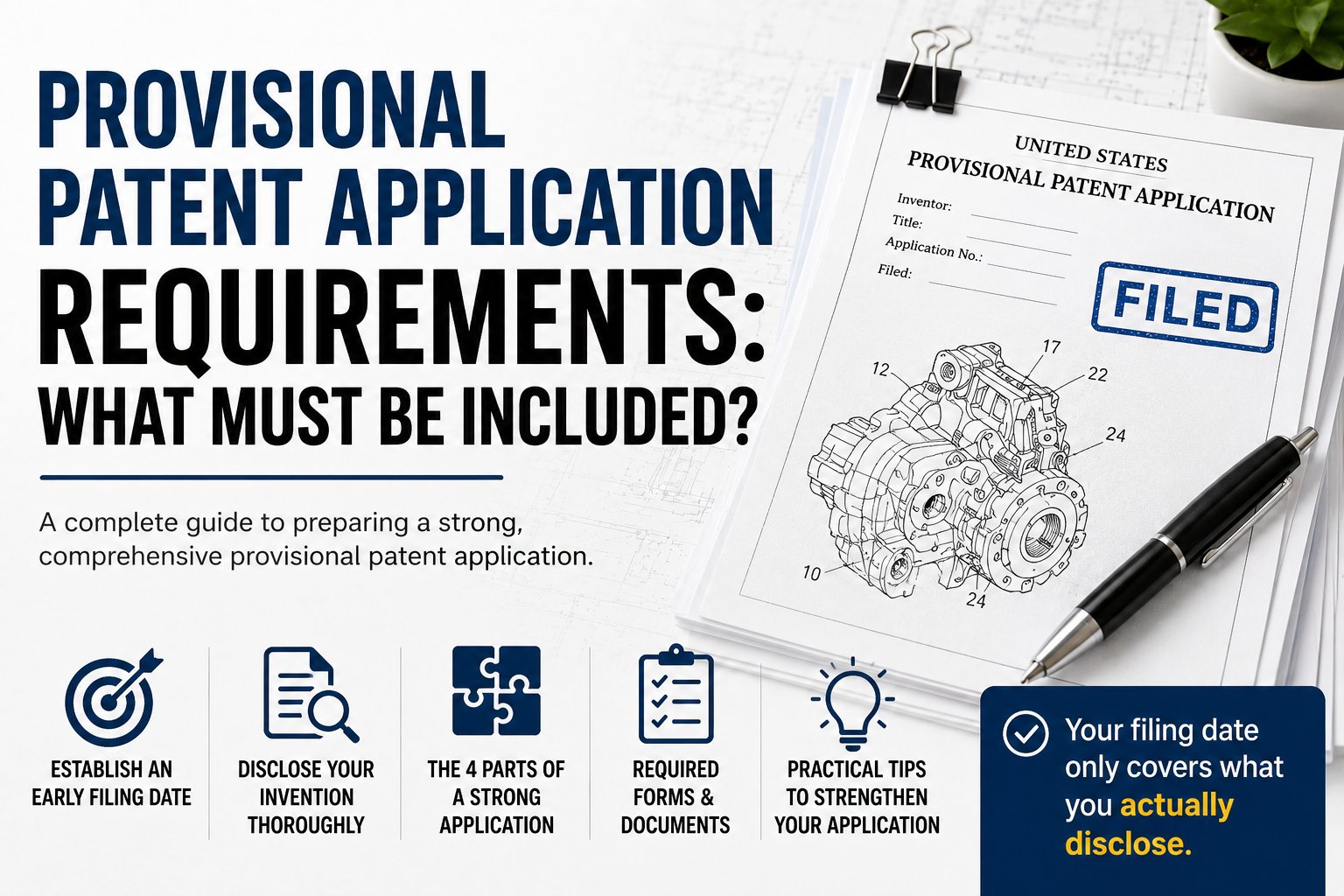
Provisional Patent Application Requirements: What Must Be Included?
If you're preparing a provisional patent application without the assistance of a patent attorney, one of the most important questions you can ask is:
What actually needs to be included in the application?
The answer is more important than many inventors realize.
If your provisional patent application leaves out important implementation details, you may permanently lose your filing date for those aspects of your invention. That can significantly affect your ability to obtain meaningful patent protection later.
One of the biggest misconceptions about provisional patent applications is that they can be very short and simply describe an invention at a high level. In reality, a provisional patent application only establishes a filing date for what you actually disclose.
In this guide, we'll discuss:
Watch: Understanding Provisional Application Requirements
A quick overview of what you need to include to protect your filing date and your invention.
The Primary Goal of a Provisional Patent Application
Before discussing what belongs in a provisional patent application, it's important to understand what the application actually accomplishes.
A provisional patent application allows an inventor to establish an early filing date for an invention.
Unlike a non-provisional patent application:
- it is not examined by the USPTO;
- it never matures directly into a patent; and
- it generally remains pending for one year.
Within that one-year period, you'll typically file a corresponding non-provisional patent application claiming priority to the provisional application.
The Most Important Principle
The single most important concept to understand is this:
A provisional patent application only establishes a filing date for what you actually disclose.
The USPTO does not publish a checklist telling inventors exactly what technical content must be included.
Instead, your goal should be to prepare a disclosure that fully supports the patent claims you may eventually pursue in your non-provisional application.
If your provisional application only describes the invention in general terms—but your later patent application introduces implementation details that were never disclosed—you may not receive the benefit of your earlier filing date for those features.
How Comprehensive Should Your Disclosure Be?
One of the most common questions inventors ask is:
"How much detail is enough?"
As a general rule:
The more complete your disclosure is, the better.
Every invention is different, but your objective should always be to describe the invention as thoroughly as reasonably possible.
Don't simply explain what the invention does.
Explain how it works.
For example, consider describing:
- individual components
- relationships between those components
- process flows
- algorithms
- implementation details
- operational steps
- alternative embodiments
- optional features
- variations
The more implementation details you disclose, the stronger your priority position is likely to be.
The Four Parts of a Strong Provisional Patent Application
Although the USPTO does not require provisional patent applications to follow a particular format, organizing the application similarly to a non-provisional application provides significant advantages.
It makes the later non-provisional application easier to prepare while helping ensure that your disclosure adequately supports future patent claims.
Part 1 — The Specification
The specification is the written description of your invention.
This is by far the most important—and usually the most time-consuming—part of the application.
A well-prepared specification generally includes:
- Background
- Summary of the Invention
- Detailed Description
Background
The Background explains the existing technology and identifies problems, shortcomings, or limitations that your invention addresses.
It provides context for why the invention was developed.
Summary
The Summary introduces the invention at a high level and briefly describes the concepts that distinguish it from prior technology.
Think of it as a roadmap for the remainder of the application.
Detailed Description
The Detailed Description is where you explain your invention in depth.
Depending on the technology, this may include:
Mechanical inventions
- components
- structural relationships
- physical interactions
Software inventions
- system architecture
- flowcharts
- algorithms
- software modules
- process flows
Electronic inventions
- circuit architecture
- signal flow
- hardware components
- software interaction
- communication between devices
Regardless of the technology involved, your objective remains the same:
Describe the novel aspects of the invention in as much detail as reasonably possible.
Avoid Purely Functional Descriptions
One of the most common mistakes inventors make is describing only what the invention accomplishes.
Instead, explain how the invention accomplishes those functions.
Those implementation details often become critically important later during patent examination.
Other Optional Sections
If you wish to mirror the structure of a non-provisional application, you may also include:
- Field of the Invention
- Brief Description of the Drawings
These sections are relatively short but can help organize the application.
Part 2 — Drawings
Although drawings are not required for every invention, most well-prepared provisional applications include them.
Depending on the invention, drawings may include:
- flowcharts
- block diagrams
- system architecture diagrams
- network diagrams
- decision trees
- algorithms
- product illustrations
- mechanical drawings
Good drawings often communicate complicated concepts far more effectively than text alone.
Remember that your Detailed Description should explain each drawing included in the application.
Part 3 — Claims
Many inventors are surprised to learn that claims are not required in a provisional patent application.
Because provisional applications are not examined, many inventors simply omit them.
Personally, I generally recommend including at least a preliminary claim set.
Drafting claims often reveals missing disclosure.
In fact, many patent attorneys draft the claims first and then prepare the written description needed to support those claims.
Although the USPTO will accept a provisional application without claims, including them often results in a stronger overall disclosure.
Part 4 — Abstract
An Abstract is optional for a provisional patent application.
Although it is not particularly important, including one generally does no harm.
If included, it should generally:
- be 150 words or less
- briefly summarize the invention
Required USPTO Forms
In addition to the patent application itself, you'll typically need to submit several USPTO forms.
The most important is the Application Data Sheet (ADS).
The exact forms required depend on your filing.
For a complete walkthrough, see our guide on filing a provisional patent application through USPTO Patent Center.
Practical Tips
If you're preparing your own provisional patent application, keep these principles in mind:
- Focus on explaining how the invention works—not just what it does.
- Include alternative embodiments whenever possible.
- Use drawings to support the written description.
- Consider drafting preliminary claims to identify missing disclosure.
- Organize your application similarly to a non-provisional application.
- Remember that your filing date only applies to what you actually disclose.
Frequently Asked Questions
Is a patent attorney required to file a provisional patent application?
No. Inventors are permitted to prepare and file provisional patent applications on their own. However, because a provisional application only establishes a filing date for what it actually discloses, it's important to prepare a comprehensive technical description of the invention.
Are claims required in a provisional patent application?
No. Claims are not required because provisional patent applications are not examined by the USPTO. However, including at least a preliminary claim set is often beneficial because it can help identify gaps in your disclosure and ensure your specification supports the invention you ultimately want to protect.
Are drawings required?
Not always. However, drawings are strongly recommended for most inventions because they often communicate technical concepts more clearly than text alone and help support the written description. For many mechanical, electrical, and software inventions, drawings can be an important part of a complete disclosure.
Is an abstract required?
No. An abstract is optional for a provisional patent application. If you include one, it should generally be limited to about 150 words and provide a concise summary of the invention.
Can I simply describe my idea?
Usually not. A provisional application should describe how the invention is implemented, not merely the concept behind it. If you are still at the idea stage, our step-by-step guide to patenting an idea explains how much detail is needed, whether a prototype is required, and the broader path from idea to patent application.
How much detail should I include?
As a general rule, disclose as much implementation detail as reasonably possible.
Can I add information after filing my provisional patent application?
You cannot add new technical disclosure to an already-filed provisional patent application. If you develop improvements or discover important implementation details after filing, you may need to file another provisional patent application covering those additions before filing your non-provisional application.
What happens after I file a provisional patent application?
A provisional patent application generally remains pending for one year. Before that one-year period expires, you'll typically file a non-provisional patent application claiming priority to the provisional application if you wish to pursue patent protection. If no corresponding non-provisional application is filed within the applicable deadline, the provisional application will generally expire.
Final Thoughts
The most important principle to remember is simple:
Your provisional patent application only establishes a filing date for what you actually disclose.
The more thoroughly you describe your invention—including implementation details, alternative embodiments, drawings, and supporting information—the stronger your provisional application is likely to be.
If you're preparing a provisional patent application yourself, consider trying Idea2PatentAI.
Our AI-powered patent drafting platform was specifically designed for inventors, entrepreneurs, and startups with no legal or patent drafting experience. Simply describe your invention in your own words, and our guided workflow helps you prepare a more comprehensive provisional patent application.
Article Information
By Idea2PatentAI Editorial Team
Reviewed by U.S. Patent Attorney (16+ years of experience)
Last updated:
Related Articles:
- Ultimate Guide: Provisional Patent Applications (PPA) in the Age of Artificial Intelligence (AI)
- Provisional Patent Application Requirements for Software, Algorithms & MVPs (DIY Guide)
Editorial Standards
This article is prepared by the Idea2PatentAI editorial team and reviewed for technical accuracy by a U.S. Patent Attorney. It is provided for educational purposes only and does not constitute legal advice. Reading this article or using Idea2PatentAI does not create an attorney-client relationship. For advice regarding your specific situation, consult a qualified attorney.
We aim to keep our content current and accurate; however, laws, regulations, and USPTO practices can change. If you believe this page contains an error, please contact us. For more information about our content standards, visit our Editorial Policy.
DISCLAIMER NOTICE: The Idea2PatentAI blog is provided for informational purposes only. Idea2PatentAI is not a law firm and nothing on this website constitutes legal advice. Users are encouraged to consult with qualified patent attorneys or other legal professionals for legal guidance or questions.