Can ChatGPT Write a Patent Application?
Yes—but there's a catch.
Tools like ChatGPT, Claude, and other large language models (LLMs) can absolutely generate something that looks like a patent application. They can produce sections like a Background, Summary, Detailed Description, and even patent claims.
The problem is that looking like a patent application isn't the same as being a strong patent application.
Patent applications aren't judged by how polished they appear—they're judged by whether they adequately disclose the invention and support the patent claims you ultimately seek to obtain.
In this article, we'll discuss why relying solely on general-purpose AI can be risky, where these tools can still provide value, and how AI can be combined with patent expertise to produce much stronger results.
The Short Answer: Yes
If your goal is simply to generate a draft, ChatGPT and similar AI tools can certainly help.
They can:
- organize information into a patent-style format;
- draft sections such as the Background, Summary, and Detailed Description;
- improve grammar and readability;
- suggest alternative wording; and
- even generate preliminary patent claims.
For many inventors, these tools provide an excellent starting point.
However, a first draft is only part of the equation.
The Biggest Problem: AI Doesn't Know What It Doesn't Know
One of the biggest risks of relying solely on a general-purpose AI model is that it often doesn't recognize what technical information is missing.
This matters because once a patent application is filed, you generally cannot add new technical subject matter.
If important implementation details were omitted from the original filing, those aspects of the invention may not receive the benefit of the original filing date and, in some cases, may not be protectable at all. For a detailed look at what must be included in a provisional patent application, see our dedicated guide.
Unlike a patent attorney, a general AI model typically doesn't know what follow-up questions to ask or what additional disclosure may be necessary to support future patent claims.
Different Technologies Require Different Disclosures
Another limitation is that patent drafting varies significantly depending on the technology involved.
For example:
Software Inventions
Software-related patent applications often require detailed discussions of:
- system architecture;
- software modules;
- algorithms;
- process flows;
- data structures;
- user interactions; and
- technical implementation details.
Mechanical Inventions
Mechanical inventions typically emphasize:
- structural components;
- physical relationships;
- dimensions;
- assemblies;
- alternative configurations; and
- manufacturing considerations.
Electrical Inventions
Electrical and electronic inventions frequently require discussion of:
- circuit architecture;
- signal flow;
- communication protocols;
- hardware components; and
- system integration.
General-purpose AI doesn't inherently understand these patent-specific differences.
Patent Claims Are Especially Difficult
Patent claims are arguably the most important part of any patent application because they define the legal scope of protection.
Drafting strong claims requires balancing competing objectives. Claims should be:
- broad enough to provide meaningful protection;
- supported by the specification;
- distinguishable over the prior art; and
- written to satisfy patent law requirements.
Finding that balance requires experience and strategic judgment.
While ChatGPT and similar models can generate claim language, they generally lack the patent-specific expertise needed to consistently draft high-quality claims.
Where ChatGPT Can Still Be Extremely Helpful
Despite these limitations, AI can still be a valuable tool during the patent drafting process.
For example, it can help:
- organize inventor notes;
- improve technical descriptions;
- rewrite confusing passages;
- brainstorm alternative embodiments;
- generate flowcharts and diagrams;
- identify additional implementation examples; and
- improve consistency throughout the application.
Used correctly, AI can dramatically accelerate preparation of a patent application.
The key is understanding where general-purpose AI performs well—and where patent-specific expertise remains important.
A Better Approach: AI Built Specifically for Patent Drafting
The solution isn't to avoid AI.
The better approach is to combine the efficiency of artificial intelligence with patent drafting expertise.
That's exactly why we built Idea2PatentAI.
Rather than simply asking a general-purpose AI model to "write a patent application," Idea2PatentAI was designed specifically for patent drafting.
The platform incorporates guidance developed by experienced patent attorneys and walks inventors through a structured, step-by-step workflow that helps gather the technical information general-purpose AI models often overlook.
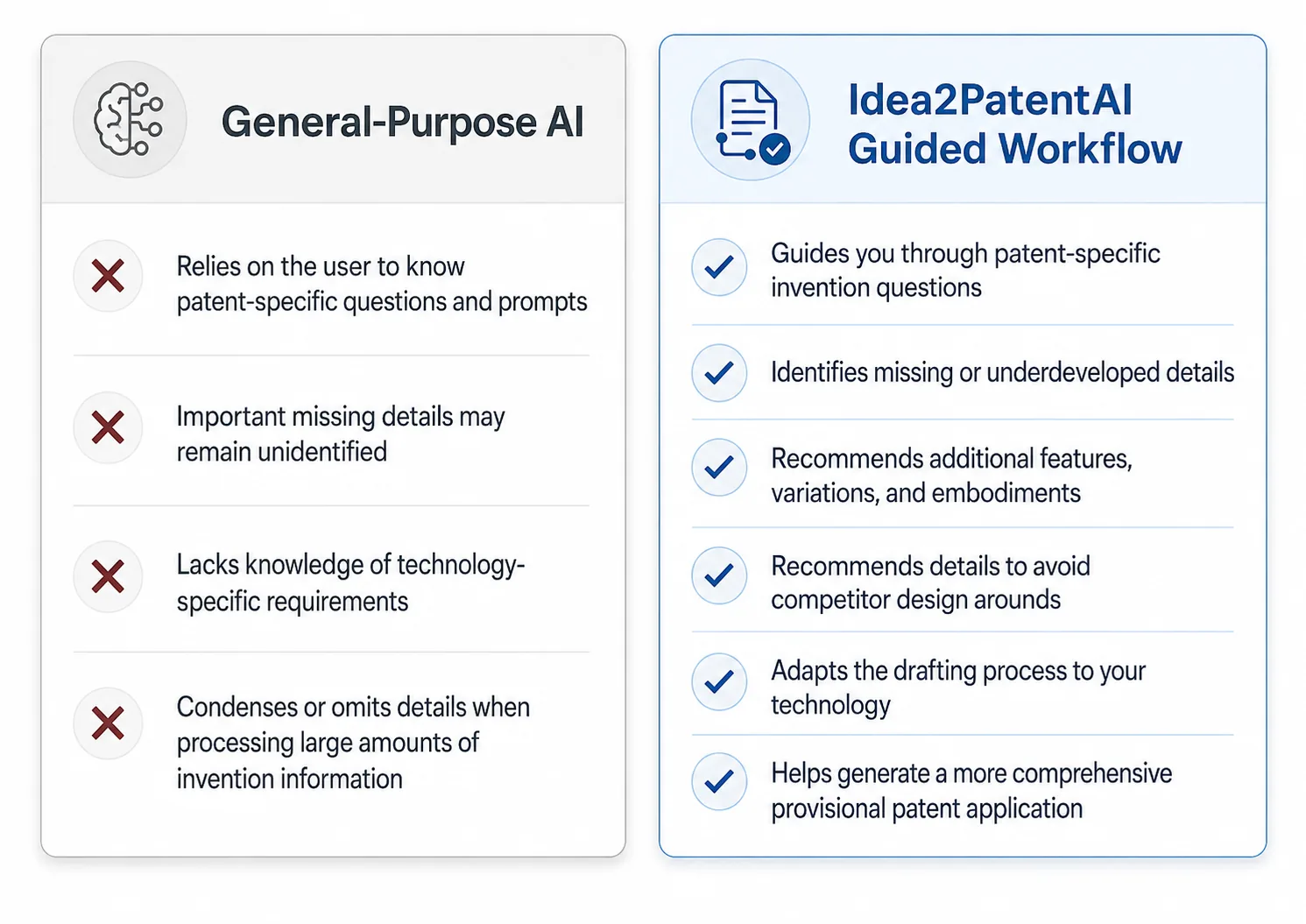
Simply describe your invention in your own words, and the platform helps prepare a more comprehensive provisional patent application—even if you've never drafted one before.
Frequently Asked Questions
Is a patent application written by ChatGPT good enough to file?
Probably not without careful review. A patent application only protects what it actually discloses, so omitted implementation details can significantly affect your future patent rights. See our guide on provisional patent application requirements to understand what should be included.
Can ChatGPT draft patent claims?
Yes, but drafting effective patent claims requires much more than producing grammatically correct language. Strong patent claims must balance breadth, support, and patentability, which often requires patent-specific expertise.
Is ChatGPT better for software patents than mechanical patents?
Not necessarily. General-purpose AI lacks specialized patent knowledge for both software and mechanical inventions. Each technology requires different types of disclosure to support future patent claims. For software inventions specifically, see our guide on drafting software patent applications.
What's the best way to use AI for patent drafting?
Use AI as a drafting assistant—not as a replacement for patent expertise. AI excels at organizing information, improving writing, and generating initial drafts. Patent-specific guidance helps ensure the resulting application adequately protects the invention.
Final Thoughts
Large language models like ChatGPT and Claude have made it easier than ever to generate a patent application draft.
But a document that looks like a patent application isn't necessarily one that provides meaningful patent protection.
The strongest results typically come from combining AI with patent-specific expertise, ensuring that the application contains the implementation details, alternative embodiments, and claim support needed to protect the invention.
If you're preparing your own provisional patent application, consider trying Idea2PatentAI—our AI-powered patent drafting platform built specifically for inventors, entrepreneurs, and startups. It combines the speed of artificial intelligence with guidance developed by experienced patent attorneys to help you prepare a more comprehensive patent application.
For a broader overview of how general-purpose AI and patent-specific systems fit within the patent-drafting process, see our AI Patent Drafting: The Complete Guide.
Article Information
By Idea2PatentAI Editorial Team
Reviewed by U.S. Patent Attorney (16+ years of experience)
Last updated:
Related Articles:
Editorial Standards
This article is prepared by the Idea2PatentAI editorial team and reviewed for technical accuracy by a U.S. Patent Attorney. It is provided for educational purposes only and does not constitute legal advice. Reading this article or using Idea2PatentAI does not create an attorney-client relationship. For advice regarding your specific situation, consult a qualified attorney.
We aim to keep our content current and accurate; however, laws, regulations, and USPTO practices can change. If you believe this page contains an error, please contact us. For more information about our content standards, visit our Editorial Policy.
DISCLAIMER NOTICE: The Idea2PatentAI blog is provided for informational purposes only. Idea2PatentAI is not a law firm and nothing on this website constitutes legal advice. Users are encouraged to consult with qualified patent attorneys or other legal professionals for legal guidance or questions.