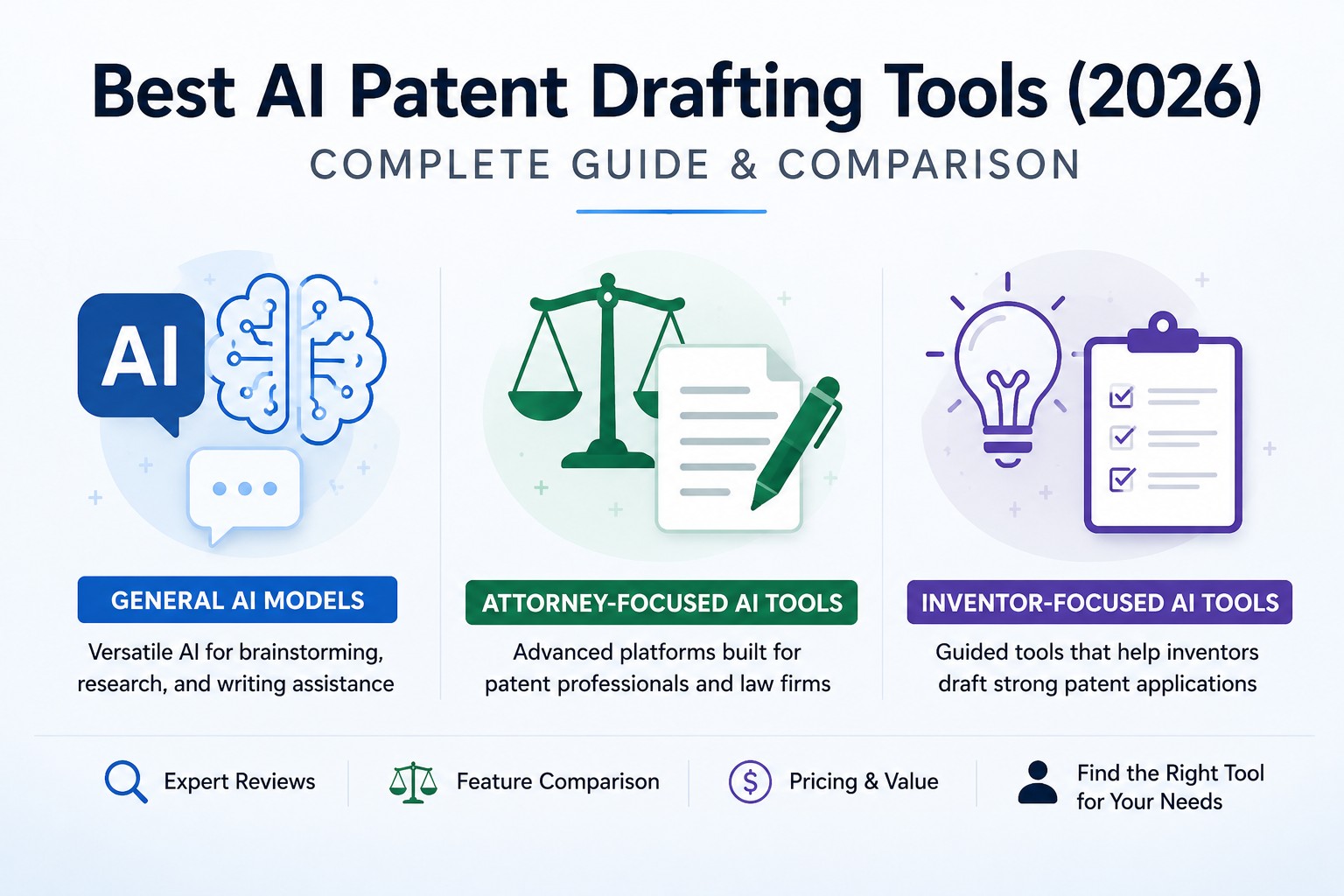
Best AI Patent Drafting Tools (2026): Complete Guide & Comparison
AI patent drafting tools have advanced rapidly, giving inventors, startups, patent attorneys, and corporate IP teams a growing number of ways to use artificial intelligence during patent preparation.
But the products now marketed as AI patent drafting software are very different from one another.
Some are sophisticated drafting environments built for experienced patent attorneys. Others are designed specifically for inventors and startups, providing guided workflows that help users develop invention details before generating a patent application draft. Still others primarily automate proofreading, claims, figures, or repetitive patent-preparation tasks. General-purpose AI systems such as ChatGPT and Claude can also assist with patent-related writing, but they do not provide the specialized workflows of dedicated patent software.
And a tool designed for a patent attorney is not necessarily the right tool for an inventor preparing a provisional patent application.
This guide compares 12 AI patent drafting tools available in 2026, organized into four categories:
- AI patent drafting tools for inventors and startups
- AI patent drafting platforms for patent attorneys and IP professionals
- Patent drafting and quality-control software
- General-purpose AI tools that can assist with patent drafting
If you are new to this technology and want to understand how it works before comparing specific products, see our AI Patent Drafting: The Complete Guide.
As a registered U.S. patent attorney with more than 16 years of experience drafting and prosecuting patent applications, I have evaluated numerous AI-assisted patent drafting and prosecution tools. I have also used some of the leading professional platforms extensively in actual patent practice.
The goal of this comparison is not to identify one tool that is universally best. Instead, it is to help you identify the strongest option based on your specific needs, including whether you are an inventor or patent professional, your level of patent-drafting experience, your preferred workflow, and your budget.
How We Evaluated the Best AI Patent Drafting Tools
A strong patent application involves considerably more than generating polished patent-style language.
An effective drafting process should help capture sufficient technical detail, support meaningful claim scope, describe alternative embodiments, maintain consistency throughout the application, and produce the type of comprehensive disclosure discussed in our guide to high-quality patent applications.
Accordingly, the tools in this guide were evaluated primarily on their usefulness for actual patent drafting rather than simply the quality of the underlying large language model.
| Criterion | Description |
|---|---|
| Intended User | Is the software designed for inventors, patent attorneys, patent agents, corporate IP teams, or general users? |
| Patent-Specific Workflow | Does the platform provide a workflow specifically designed around patent preparation, or is the user simply interacting with a general-purpose AI model? |
| Specification Drafting | How effectively does the software assist with preparing the written description, background, summary, embodiments, abstract, and other application sections? |
| Claim Drafting | Does the platform assist with drafting and refining patent claims? |
| Invention Development & Missing Details | Does the software merely draft from the information supplied, or does it help identify missing, vague, or underdeveloped invention details before or during drafting? |
| Pricing & Value | Does the cost model fit the intended user's budget and needs? |
| Privacy & Security | What controls does the provider describe for protecting confidential patent information? |
Quick Comparison: 12 AI Patent Drafting Tools
| Tool | Category | Best For | Rating | Pricing |
|---|---|---|---|---|
| Idea2PatentAI | Inventor-focused | Inventors, startups & non-attorneys | ★★★★★ (5.0/5) | $79/application; "99 3-pack |
| Solve Intelligence | Attorney-focused | Patent attorneys & law firms | ★★★★★ (5.0/5) | Contact sales |
| DeepIP | Attorney-focused | Patent professionals; Word-centric workflows | ★★★★☆ (4.5/5) | Contact sales |
| Patlytics | Attorney-focused | IP teams wanting drafting + broader intelligence | ★★★☆☆ (3.5/5) | Contact sales |
| Rowan Patents (Clarivate) | Attorney-focused | Professional integrated patent drafting | ★★★☆☆ (3.4/5) | Contact sales |
| Qatent by Questel | Attorney-focused | Self-service professional AI drafting | ★★★☆☆ (3.3/5) | €200/month or €2,000/year |
| IP Author | Attorney-focused | Law firms & corporate patent teams | ★★★☆☆ (3.2/5) | From $499/month or $4,800/year |
| Patent Bots | Drafting & quality control | Patent drafting, proofreading & workflow automation | ★★★★☆ (4.5/5) | From $702/year |
| ClaimMaster | Drafting & quality control | Word-based patent drafting & proofreading | ★★★★☆ (4.3/5) | Up to $75/user/month |
| PatentPal | Drafting & quality control | Claim-to-specification and figure automation | ★★★☆☆ (3.2/5) | Not publicly listed |
| ChatGPT | General-purpose AI | Brainstorming & general drafting assistance | ★★☆☆☆ (2.0/5) | Free; Plus $20/month |
| Claude | General-purpose AI | Technical and long-form drafting assistance | ★★☆☆☆ (2.0/5) | Free; Pro $20/month |
Pricing above reflects publicly available information reviewed in August 2026 and may change.
Types of AI Patent Drafting Tools
Before comparing individual products, it is important to understand that these tools address very different problems.
1. Inventor-Focused AI Patent Drafting Platforms
Inventors and startup founders face a different challenge from experienced patent attorneys. A patent attorney generally already understands issues such as enablement, written description, claim strategy, alternative embodiments, implementation detail, and technology-specific drafting requirements.
An inventor, or other non-attorney user, may understand the invention extremely well but have little experience determining what information needs to be included in a patent application. Inventor-focused AI platforms therefore need to do more than generate patent-style text. Ideally, they should guide the inventor through describing the invention, help identify missing or underdeveloped details, and translate that information into a structured application draft.
2. AI Patent Drafting Platforms for Patent Attorneys and IP Professionals
Attorney-focused tools take essentially the opposite approach. They generally assume the user already understands patent drafting and prosecution strategy. Typically, the AI serves as an advanced drafting copilot that can accelerate tasks such as:
- preparing claims and specification sections;
- integrating invention disclosures into a knowledge base of the drafting copilot;
- modifying drafts through conversational AI;
- adapting output to preferred drafting styles;
- analyzing prior art;
- assisting with Office Action responses; and
- integrating into established professional workflows.
Solve Intelligence and DeepIP remain the strongest tools I have evaluated in this category.
3. Patent Drafting and Quality-Control Software
A separate category of patent software combines AI with more traditional drafting automation and quality-control functions, typically leveraged by attorneys to refine and finalize application drafts. These platforms may provide capabilities such as:
- antecedent-basis checking;
- specification-support analysis;
- claim consistency review;
- automated specification sections;
- figure and reference-number management;
- Word automation;
- Office Action shells and forms; and
- other patent-prosecution utilities.
Patent Bots and ClaimMaster are particularly strong examples of this category.
4. General-Purpose AI Models
ChatGPT and Claude are extraordinarily capable general-purpose AI systems. With effective prompting, both can generate patent-style language, explain complex technology, brainstorm alternative embodiments, revise claims, and assist experienced practitioners with many drafting tasks.
Their primary limitation is that they are not patent drafting platforms. They do not inherently provide the structured invention-capture processes, patent-specific workflows, drafting controls, quality checks, or draft-editing environments offered by dedicated patent software. Most importantly, they lack built-in patent-specific drafting guidance, leaving the user to know what information to provide and how to prompt the AI effectively.
For a deeper discussion of this distinction, see Can ChatGPT Write a Patent Application?
Best AI Patent Drafting Tool for Inventors & Startups
Idea2PatentAI

Official Website: idea2patentai.com
Best For: Inventors, entrepreneurs, startups, small businesses, and non-attorneys
Overall Patent Drafting Rating: ★★★★★ (5.0/5) — Best for Inventors, Startups & Non-Attorneys
Idea2PatentAI is designed specifically for users who understand their inventions but may have little or no experience drafting patent applications. Rather than expecting the user to know which patent-law issues to address or how to prompt AI to account for important patent-drafting considerations, the platform guides the inventor through an AI-assisted workflow to develop the invention disclosure before drafting begins, and then applies built-in patent-specific drafting guidance to generate a more comprehensive application draft.
The distinction between Idea2PatentAI and attorney-focused platforms is particularly important. Professional drafting software generally assumes the user already knows how to identify deficiencies in an invention disclosure. Idea2PatentAI is designed around helping a non-attorney develop a more complete disclosure before the application is generated.
A typical user who provides approximately 500 words describing an invention can often generate an application of approximately 35–55 pages, depending on the invention and information supplied. You can learn more about the guided process on the How Idea2PatentAI Works page.
Key Strengths
- Patent-specific guided workflow designed for non-attorneys
- No patent drafting experience needed
- Structured invention-detail collection
- AI analysis designed to identify missing, vague, or underdeveloped invention details
- Recommendations for additional embodiments, implementations, and potential uses
- Technology-specific drafting adaptation
- Generation of a complete provisional patent application draft
- Integrated AI-assisted application editor
- Manual editing capability within editing environment
- Word and PDF downloads
- Step-by-step DIY filing resources
- Optional access to independent patent attorneys through the Attorney Referral Network
Limitations
- Focused primarily on provisional patent application preparation
- Not intended to provide the advanced prosecution environment required by experienced patent practitioners
- Does not replace individualized legal advice or patent strategy from an attorney
- Professional patent attorneys may prefer platforms that integrate directly into their existing prosecution and Microsoft Word workflows
Pricing
A single application package is currently $79 as a one-time purchase, with a three-application bundle available for "99. There is no recurring subscription requirement. See the current Idea2PatentAI pricing options.
Privacy and Security
Idea2PatentAI is designed to protect sensitive invention information and give users control over the application data they submit and generate.
- No Training on Your Invention Details: Your invention details and generated application content are not used to train or improve general AI models.
- Control Over Your Application Data: Users can permanently delete invention information and generated application data from Idea2PatentAI’s servers through their account dashboard.
- Encryption: Data is protected using industry-standard encryption, including TLS 1.2+ encryption for data in transit and AES-256 server-side encryption for stored data.
Bottom Line
Idea2PatentAI addresses a fundamentally different problem than most professional AI patent drafting platforms. Instead of assuming the user has substantial knowledge of patent drafting, it helps inventors develop the information that a comprehensive patent application should contain and then converts that information into a structured draft with built-in expert drafting guidance. For inventors, startups, and other non-attorney users seeking a guided self-service patent drafting option, Idea2PatentAI is our top choice among the products reviewed.
Best AI Patent Drafting Platforms for Patent Attorneys & IP Professionals
1. Solve Intelligence
Official Website: solveintelligence.com
Best For: Patent attorneys, patent agents, law firms, and sophisticated corporate IP teams
Overall Patent Drafting Rating: ★★★★★ (5.0/5) — Best Overall for Patent Attorneys
Solve Intelligence remains my top choice among attorney-focused AI patent drafting platforms.
The platform has evolved well beyond basic specification generation. Its current product supports invention harvesting, interactive patent application drafting, figures and technical content, Office Action responses, claim charts, and other patent workflows. It also allows attorneys to customize output by drafting style, jurisdiction, technology field, client, and individual preference.
Key Strengths
- Excellent toolset of patent application drafting capabilities
- Strong claim and specification generation
- Interactive AI drafting rather than purely one-click generation
- Highly customizable drafting styles and templates
- Support for different technologies and jurisdictions
- Figure-generation and editing capabilities
- Office Action analysis and response drafting
- Invention disclosure ingestion
- Broad prosecution and claim-analysis functionality
- Mature professional workflow
- Strong enterprise security controls
Limitations
- Assumes substantial patent drafting and prosecution knowledge
- Not designed as a guided self-service product for inventors
- Professional-platform pricing is substantially higher than consumer AI tools or inventor-focused drafting platforms
- Its large feature set may exceed the needs of users simply seeking help preparing one application
Pricing
Pricing is not publicly listed and may vary based on the number of users and other factors. Contact Solve Intelligence for current pricing.
Privacy and Security
Solve states that uploaded and generated data is not used to train AI models and offers enterprise security and data-protection controls for professional patent practices.
My Experience
I have used Solve Intelligence extensively in my own patent practice. Of the attorney-focused AI patent drafting tools I have evaluated, it remains the strongest overall platform. Its biggest advantage is not merely its ability to generate text. It provides an iterative drafting environment in which an experienced practitioner can develop claims, expand embodiments, revise sections, analyze issues, and continuously refine an application while remaining in control of the drafting strategy.
Bottom Line
Solve Intelligence is one of the most mature and capable AI patent drafting platforms currently available to patent professionals. For experienced patent attorneys seeking a comprehensive AI drafting and prosecution environment, Solve is my top choice.
2. DeepIP
Official Website: deepip.ai
Best For: Patent attorneys, patent agents, European practitioners, and teams that prefer Microsoft Word integration
Overall Patent Drafting Rating: ★★★★☆ (4.5/5) — Best for Word-Centric and European Patent Workflows
DeepIP is another excellent professional AI patent platform and remains one of Solve Intelligence’s strongest alternatives.
The platform supports complete patent application generation from invention disclosures, including claims, specifications, and abstracts, together with patent-office compliance features and Microsoft Word integration. It has expanded into prior-art searching, patentability analysis, Office Action responses, and other patent-intelligence workflows.
Key Strengths
- Excellent AI-assisted patent drafting
- Complete claims and specification generation
- Microsoft Word integration
- Customizable workflows and drafting style
- USPTO, EPO, and PCT-oriented functionality
- Office Action analysis and response preparation
- Prior-art and patentability tools
- Support for multiple document and media inputs
- Broad technology coverage
- Enterprise-grade security
Limitations
- Generally has the same limitations as Solve Intelligence
- Designed around professional users who already understand patent law and drafting strategy
- Less suitable for inventors seeking a guided do-it-yourself workflow
- Heavy price tag
- As with other practitioner platforms, the user remains responsible for evaluating the legal and technical quality of the output
Pricing
Pricing is not publicly listed and may vary based on the number of users, organization size, and selected features. Contact DeepIP for current pricing.
Privacy and Security
DeepIP’s website describes enterprise-focused security and data controls designed for confidential patent work.
My Experience
I have also used DeepIP for an extended period. It is a sophisticated platform with particularly strong workflow integration. Its Microsoft Word extension is especially useful for practitioners who want AI assistance without abandoning the environment in which they already draft and revise patent applications. I still rank Solve slightly higher overall, but DeepIP remains one of the strongest professional AI patent drafting products available.
Bottom Line
DeepIP is an excellent choice for experienced patent professionals seeking sophisticated AI drafting within a practitioner-oriented workflow. It is particularly compelling for Word-centric practices and teams handling U.S. and European patent work.
3. Patlytics

Official Website: patlytics.ai
Best For: Law firms and corporate IP teams seeking patent drafting together with broader patent intelligence
Overall Patent Drafting Rating: ★★★☆☆ (3.5/5) — Best for Combining Drafting with Broader Patent Intelligence
Patlytics has developed into a broad AI-powered patent intelligence platform covering significantly more than drafting alone.
Its patent-drafting functionality can generate application drafts from invention disclosures and work within a broader environment that also includes invention-disclosure workflows, Office Action functionality, patent and non-patent-literature searching, claim analysis, and broader portfolio and litigation-oriented tools.
Key Strengths
- Full application drafting from invention disclosures
- Contextual AI drafting functionality
- Custom templates and prompts
- Patent and non-patent-literature search
- Invention disclosure management
- Office Action functionality
- Broader patent-intelligence and analysis capabilities
- Strong appeal for corporate IP departments
- Enterprise security controls
Limitations
- Broader patent-intelligence scope may be more than a practitioner needs if drafting is the only objective
- Less long-term drafting maturity, in my assessment, than Solve Intelligence and DeepIP
- Pricing is not publicly displayed
- Built primarily for professional and enterprise users rather than first-time inventors
Pricing
Patlytics does not publicly list standard subscription pricing on its primary product pages.
Privacy and Security
Patlytics describes enterprise-oriented security and data controls for handling confidential patent information.
Bottom Line
Patlytics is a strong and rapidly developing platform, particularly for organizations that want to combine patent drafting with search, analysis, portfolio intelligence, and other IP workflows. For pure attorney-focused drafting, I currently rank Solve and DeepIP higher. But Patlytics is an increasingly important platform and earns the third position in this category.
4. Rowan Patents by Clarivate

Official Website: clarivate.com/rowan-patents
Best For: Patent professionals seeking an integrated drafting environment
Overall Patent Drafting Rating: ★★★☆☆ (3.4/5)
Rowan Patents is an established patent drafting platform that is now part of Clarivate.
The product combines an integrated patent-drafting environment with AI assistance and patent-specific automation. One notable differentiator is its integrated drawing functionality, which can help coordinate figures and part references with claims and specification content.
Key Strengths
- Purpose-built patent drafting environment
- AI-assisted professional drafting
- Integrated drawing tools
- Patent-specific document automation
- Patent-specific workflow rather than a generic AI interface
- Backing and integration potential from the broader Clarivate IP ecosystem
- Designed for law firms and corporate IP teams
Limitations
- Primarily designed for experienced patent practitioners
- Less conversationally AI-centric than some newer platforms
- Pricing is not publicly displayed
- May appeal more to users seeking an integrated drafting environment than users seeking a broad AI patent copilot
Pricing
Clarivate does not publicly list standard Rowan Patents subscription pricing on its current product pages.
Privacy and Security
Rowan Patents is part of the Clarivate enterprise suite and is designed for professional patent-work environments.
Bottom Line
Rowan Patents remains a credible professional patent drafting product, particularly for practitioners who value integrated drafting, drawing, reference-number, and document-consistency tools. Its patent-specific environment distinguishes it from general-purpose AI, although I currently place Solve, DeepIP, and Patlytics ahead of it for overall AI-assisted patent drafting.
5. Qatent by Questel

Official Website: questel.com/qatent
Best For: Patent professionals seeking focused, self-service AI patent drafting
Overall Patent Drafting Rating: ★★★☆☆ (3.3/5)
Qatent is Questel’s self-service AI patent drafting solution.
It can generate claims and full application drafts, work from existing claims or invention disclosures, imitate the style of a reference patent, incorporate prior-art information into the drafting process, describe drawings, manage reference numerals, and support multiple drafting languages.
Key Strengths
- Focused specifically on AI patent drafting
- Full application generation
- Claim generation
- Prior-art integration
- Ability to imitate a guiding patent or preferred drafting style
- Drawing-description functionality
- Reference numeral management
- Multilingual drafting support
- Questel patent-data integration
- Transparent subscription pricing
Limitations
- Less comprehensive prosecution environment than the leading attorney-focused platforms
- Practitioner expertise remains important for evaluating claims and specification quality
- More structured/self-service in nature than some conversational AI copilots
- Higher cost than general-purpose AI and inventor-focused one-time products
Pricing
Questel currently lists Qatent at approximately €200 per user per month or €2,000 per user per year, excluding applicable tax.
Privacy and Security
Questel’s website emphasizes confidentiality, security, and professional control as part of Qatent’s patent-drafting environment.
Bottom Line
Qatent is one of the more directly focused AI patent drafting products in this comparison. Its combination of patent generation, prior-art functionality, multilingual support, and transparent self-service pricing makes it worth considering, particularly for practitioners who want a dedicated drafting product without purchasing a broader enterprise AI platform.
6. IP Author
Official Website: ipauthor.com
Best For: Patent attorneys, law firms, and corporate IP departments seeking an integrated patent lifecycle platform
Overall Patent Drafting Rating: ★★★☆☆ (3.2/5)
IP Author combines patent drafting with invention disclosure, prior-art searching, Office Action support, and other patent-management functionality.
Its drafting module generates claims and specifications from invention disclosures and also supports technical elements such as flowcharts and block diagrams.
Key Strengths
- Claims and specification generation
- Structured invention disclosures
- Prior-art searching
- Office Action response assistance
- Flowchart and block-diagram generation
- Broader patent-lifecycle workflow
- Attorney-controlled review and editing
- Enterprise security features
Limitations
- Professional rather than inventor-oriented workflow
- Substantial annual subscription cost
- Broad feature set may be unnecessary for users focused only on drafting
- In my assessment, not at the same overall drafting level as Solve or DeepIP
Pricing
IP Author currently advertises professional patent-drafting plans starting at $499/month or $4,800/year, with additional functionality available through higher-tier offerings.
Privacy and Security
IP Author states that customer information is not used for model training and describes enterprise security and confidentiality controls for law-firm and corporate users.
Bottom Line
IP Author offers a broad patent-AI platform with meaningful drafting capabilities. It is particularly relevant to law firms and in-house teams looking for a single product spanning invention disclosure, drafting, search, and prosecution, although I currently rank the more established attorney-drafting leaders higher.
Best Patent Drafting & Quality-Control Software
These products differ somewhat from the attorney-focused platforms above. Their strengths are often found in document quality control, proofreading, patent-specific utilities, and Microsoft Word integration, rather than attempting to operate primarily as an end-to-end patent drafting tool.
1. Patent Bots

Official Website: patentbots.com
Best For: Patent attorneys wanting strong drafting, proofreading, and prosecution utilities
Overall Rating: ★★★★☆ (4.5/5) — Best Patent Drafting & Quality-Control Tool
Patent Bots has built a substantial suite of tools designed around the everyday work of patent practitioners.
Its current products combine rule-based and generative-AI functionality for patent proofreading, patent drafting, Office Action workflows, IDS preparation, USPTO forms, and other patent tasks. The platform also includes examiner statistics and additional prosecution tools.
Key Strengths
- Excellent patent proofreading
- Generative-AI patent drafting tools
- Patent-specific quality control
- Office Action administration tools
- IDS and USPTO form automation
- Microsoft Word integration
- Examiner statistics
- Broader prosecution utilities
- Professional patent-practice workflow
- Relatively accessible pricing for individual practitioners
Limitations
- More of a patent-practice productivity suite than a single end-to-end AI drafting platform
- Primarily designed for patent practitioners
- Users seeking highly interactive invention-development and drafting agents may prefer Solve or DeepIP
- Some features are oriented particularly toward U.S. prosecution practice
Pricing
Patent Bots currently lists individual-practitioner options beginning at approximately $702 per year for certain product packages. Firm-wide pricing varies based on firm size and products selected.
Privacy and Security
Patent Bots is designed for professional patent-practice environments and handles confidential patent materials accordingly.
Bottom Line
Patent Bots is one of the strongest tools available for attorneys who want to combine AI drafting assistance with excellent patent-specific proofreading and prosecution automation. For that reason, it receives the highest rating in the drafting and quality-control category.
2. ClaimMaster

Official Website: claimmaster.com
Best For: Patent attorneys wanting powerful Microsoft Word-based drafting, proofreading, and automation
Overall Rating: ★★★★☆ (4.3/5)
ClaimMaster is one of the most established patent-specific productivity tools in this comparison.
It operates as a Microsoft Word-based environment and combines sophisticated patent proofreading with drafting automation, claim tools, specification generation, figures and flowcharts, Office Action shells, USPTO forms, and patent-data utilities.
Key Strengths
- Excellent patent proofreading
- Antecedent-basis and claim consistency checking
- Specification-support analysis
- Microsoft Word integration
- AI-assisted specification drafting
- Claim automation
- Figures and flowcharts
- Reference-number tools
- Office Action shell generation
- USPTO forms
- Highly customizable templates and rules
- Local/on-premise operation for core software
Limitations
- More traditional utility/add-in workflow than newer agentic AI platforms
- Professional patent expertise is assumed
- Focuses heavily on drafting efficiency and quality control rather than guided invention development
- Windows/Microsoft Word-centric architecture may not fit every workflow
Pricing
ClaimMaster offers multiple subscription levels, with its fuller drafting-oriented plans currently reaching approximately $75 per user per month.
Privacy and Security
ClaimMaster’s core software operates locally on the user’s computer or network, which can be attractive to practitioners concerned about transmitting confidential patent documents through cloud-based systems.
Bottom Line
ClaimMaster remains an excellent product for patent practitioners who want Word-based drafting automation combined with unusually strong proofreading and quality-control tools. It is less of a modern conversational drafting copilot than Solve or DeepIP, but as a patent drafting and QA utility, it remains one of the strongest products available.
3. PatentPal
Official Website: patentpal.com
Best For: Patent professionals seeking automated specification and figure generation from claims
Overall Rating: ★★★☆☆ (3.2/5)
PatentPal takes a more specialized approach to AI-assisted patent drafting.
Users can input claims and use the platform to generate specification material and figures, including method flowcharts, system block diagrams, figure descriptions, summaries, and abstracts. Draft content can then be exported into Word, Visio, or PowerPoint.
Key Strengths
- Simple claim-driven drafting workflow
- Automated specification generation
- Flowchart generation
- Block diagrams
- Figure descriptions
- Summary and abstract generation
- Customizable drafting phrases
- Word and Visio/PowerPoint export
- Narrow workflow can be efficient for the tasks it addresses
Limitations
- Considerably narrower than comprehensive AI patent drafting platforms
- Requires expert attorney knowledge of claim drafting
- Lacks guiding invention development for inventors
- Limited prosecution functionality
- Public product information is less extensive than for many newer platforms
- Pricing is not prominently published
Pricing
Pricing is not publicly listed. Contact PatentPal for current pricing information.
Privacy and Security
PatentPal is designed for professional patent-work use.
Bottom Line
PatentPal is a useful specialized drafting product, particularly for practitioners who already have claims and want to automate specification language, figures, summaries, and other mechanical drafting work. Its narrower scope keeps it below Patent Bots and ClaimMaster in this category, but that specialization may be exactly what some practitioners need.
General-Purpose AI Tools for Patent Drafting
ChatGPT by OpenAI
Official Website: chatgpt.com
Best For: Brainstorming, technical explanations, drafting assistance, and sophisticated prompting by experienced users
Overall Patent Drafting Rating: ★★☆☆☆ (2.0/5) — Best Used as a General AI Assistant
ChatGPT is one of the most capable general-purpose AI systems available and can be extremely useful during patent work. It can help explain technology, brainstorm embodiments, reorganize technical disclosures, suggest alternative implementations, revise language, and generate patent-style sections when given appropriate instructions.
But ChatGPT is not itself a dedicated patent drafting platform.
Key Strengths
- Excellent general reasoning and writing
- Strong technical explanations
- Flexible conversational interface
- Useful brainstorming capabilities
- Can iteratively revise patent-related text
- Low cost compared with specialized professional tools
- Particularly useful to practitioners capable of creating sophisticated patent-specific prompts
Limitations
- No built-in patent drafting workflow
- No structured invention intake specifically designed for patent applications
- Patent-specific issue spotting depends heavily on prompting
- Important embodiments or implementation details can be omitted
- Output quality depends substantially on the patent knowledge of the user
- Confidential invention information should be handled only after reviewing the applicable plan’s data and privacy controls
Pricing
ChatGPT offers a free plan, while ChatGPT Plus is currently $20 per month. Additional individual and business plans are also available.
Bottom Line
ChatGPT is an outstanding general AI assistant, but it should not be confused with purpose-built AI patent drafting software. Experienced patent attorneys can obtain impressive results through sophisticated prompting. Users without patent drafting experience may have much more difficulty recognizing when important information is missing from the resulting draft. For a deeper analysis, see Can ChatGPT Write a Patent Application?
Claude by Anthropic
Official Website: claude.ai
Best For: Technical writing, analysis, long documents, and general patent drafting assistance
Overall Patent Drafting Rating: ★★☆☆☆ (2.0/5) — Best Used as a General AI Assistant
Claude is another powerful general-purpose AI system that can be useful for patent-related work. Its strengths in technical writing, document analysis, and long-form content make it a capable assistant for practitioners working with complex invention disclosures or lengthy patent materials.
Key Strengths
- Strong technical writing
- Excellent long-form drafting
- Effective document analysis
- Natural writing style
- Useful brainstorming and revision capabilities
- Low entry cost
Limitations
- Not designed specifically for patent drafting
- No dedicated patent workflow
- No structured patent-specific invention intake
- Requires patent expertise and sophisticated prompting for best results
- Users must independently identify missing embodiments, claim-support issues, and other drafting deficiencies
- Confidential invention information should be handled only after reviewing applicable privacy and plan terms
Pricing
Claude offers a free plan and currently lists Claude Pro at $20 per month when billed monthly.
Bottom Line
Claude is an excellent general-purpose technical writing assistant. Like ChatGPT, however, its usefulness for patent drafting depends heavily on the knowledge of the person directing it. It is best viewed as a powerful AI assistant rather than a replacement for patent-specific drafting software.
Which Type of AI Patent Drafting Tool Is Right for You?
There is no single AI patent drafting tool that is best for every user. The most important factor is identifying the type of problem you are trying to solve.
If You’re an Inventor or Entrepreneur
Look for software that:
- does not assume knowledge of patent law;
- helps you develop your invention disclosure;
- identifies potentially missing or vague technical information;
- provides examples and patent-specific guidance;
- generates a complete initial application draft; and
- allows you to review and edit the resulting application.
For this use case, Idea2PatentAI is our top choice among the tools reviewed. Inventors who are earlier in the process may also find our guide explaining how to patent an idea helpful.
If You’re a Startup
Startups often need to balance application quality, filing speed, and limited budgets. A guided inventor-focused platform may be appropriate when the goal is to prepare an initial provisional application without immediately incurring the cost of full attorney preparation. For higher-value inventions, complicated ownership issues, international filing strategies, or other situations requiring individualized legal judgment, attorney involvement may still be appropriate. Idea2PatentAI users can also request an introduction to an independent patent attorney through the Idea2PatentAI Attorney Referral Network.
If You’re a Patent Attorney or Patent Agent
Professional users should prioritize different characteristics:
- quality of claims and specifications;
- ability to customize drafting style;
- interactive revision;
- Microsoft Word or existing-workflow integration;
- figure support;
- jurisdiction-specific drafting;
- security;
- Office Action functionality; and
- ability to handle substantial volumes of client work efficiently.
Solve Intelligence and DeepIP remain my top two overall choices for professional AI-assisted patent drafting. Patlytics, Rowan Patents, Qatent, and IP Author provide additional alternatives depending on budget, workflow, and feature requirements.
If Quality Control and Drafting Automation Are Your Priorities
If you already have an established drafting workflow and primarily want to reduce errors and automate repetitive patent tasks, a product such as Patent Bots or ClaimMaster may be more valuable than replacing your entire drafting environment. PatentPal may also be useful when the primary objective is generating specification language and figures from an existing claim set.
If You Only Need General AI Assistance
ChatGPT and Claude may be sufficient if you:
- already understand patent drafting;
- primarily want brainstorming or writing assistance;
- are comfortable creating detailed prompts; and
- can independently review the output for omissions and legal or technical deficiencies.
Their flexibility and low cost make them valuable tools, but they require considerably more knowledge from the user. For a broader discussion, see AI Patent Drafting vs. Traditional Patent Attorney Services.
What to Look for in AI Patent Drafting Software
Patent-Specific Drafting Capabilities
The fact that software uses a powerful large language model does not automatically make it good patent software. Look at what the surrounding platform contributes: structured invention intake, claim tools, specification workflows, figure management, drafting controls, consistency checking, and other patent-specific capabilities. For more background on how these systems work, see our AI patent drafting guide.
Specification and Claim Drafting
Claims and specifications serve different purposes. A useful platform should either assist with both or make clear which part of the patent-drafting process it is designed to automate.
Ability to Identify Missing Invention Details
This is particularly important for inventors. AI cannot effectively describe information that was never provided unless the platform first identifies that the disclosure is incomplete and helps the user develop the missing subject matter. For a broader discussion of disclosure completeness, see 10 Characteristics of a High-Quality Patent Application.
Patent Expertise Required
Ask whether the tool is designed to assist a patent professional or guide someone who does not have patent expertise. That distinction may be more important than the underlying AI model.
Privacy, Confidentiality, and Data Security
Patent drafting may involve unpublished inventions and highly confidential business information. Review each provider’s current privacy, security, retention, model-training, and enterprise-control policies before uploading sensitive material.
Workflow and Microsoft Word Integration
For law firms, changing the drafting environment can create substantial friction. Tools that integrate directly into Word or otherwise fit established attorney workflows may provide more value than platforms requiring practitioners to rebuild their process.
Pricing and Subscription Model
Pricing varies enormously. General-purpose AI subscriptions may cost around $20 per month, specialized practitioner software may cost thousands of dollars per month or tens of thousands per year, and inventor-focused tools may instead use one-time application pricing. The best value therefore depends heavily on how often you draft patents and what professional capabilities you actually need.
Frequently Asked Questions About AI Patent Drafting Tools
What is the best AI patent drafting software?
What is the best AI patent drafting tool for inventors?
What is the best AI patent drafting software for patent attorneys?
What is the best patent drafting and proofreading software?
Can AI draft patent claims?
Can ChatGPT or Claude write a patent application?
How much does AI patent drafting software cost?
Is AI patent drafting software secure for confidential inventions?
Do AI patent drafting tools replace patent attorneys?
Final Recommendations: Best AI Patent Drafting Tools by Use Case
After reviewing the current market, my recommendations are:
- Best AI Patent Drafting Tool for Inventors & Non-Attorneys: Idea2PatentAI
- Best Overall AI Patent Drafting Platform for Patent Attorneys: Solve Intelligence
- Best European-Based AI Patent Drafting Platform: DeepIP
- Best for Broader Patent Intelligence: Patlytics
- Best Quality-Control Platform: Patent Bots
- Best Proofreading Tool: ClaimMaster
- Best Specialized Claim-to-Specification Automation Tool: PatentPal
- Best General-Purpose AI Assistants: ChatGPT and Claude
The most important takeaway is that the best AI patent drafting tool depends on who is using it. A patent attorney who has spent years developing a drafting style and prosecution strategy needs a sophisticated productivity platform that preserves professional control. An inventor preparing a first provisional application needs a system that helps identify what information should be disclosed before the application is drafted. And a practitioner who already has an effective drafting process may benefit most from software that improves quality control and automates repetitive tasks.
AI patent drafting has therefore evolved beyond a single category of software. The strongest products increasingly specialize around the needs of particular users—and choosing the right type of platform is just as important as choosing the underlying AI.
Article Information
By Idea2PatentAI Editorial Team
Reviewed by U.S. Patent Attorney (16+ years of experience)
Last updated:
Related Articles:
Editorial Standards
This article is prepared by the Idea2PatentAI editorial team and reviewed for technical accuracy by a U.S. patent attorney. Idea2PatentAI publishes this comparison and is one of the products evaluated.
The article is provided for educational and informational purposes only and does not constitute legal advice. Reading this article or using Idea2PatentAI does not create an attorney-client relationship.
Product functionality, pricing, privacy practices, and security features may change. Readers should verify current information directly with the applicable product provider before making a purchasing or data-security decision. For advice regarding a particular patent matter, consult a qualified patent attorney. For more information about our content standards, visit our Editorial Policy.
DISCLAIMER NOTICE: The Idea2PatentAI blog is provided for informational purposes only. Idea2PatentAI is not a law firm and nothing on this website constitutes legal advice. Users are encouraged to consult with qualified patent attorneys or other legal professionals for legal guidance or questions.