What Makes a High-Quality Patent Application
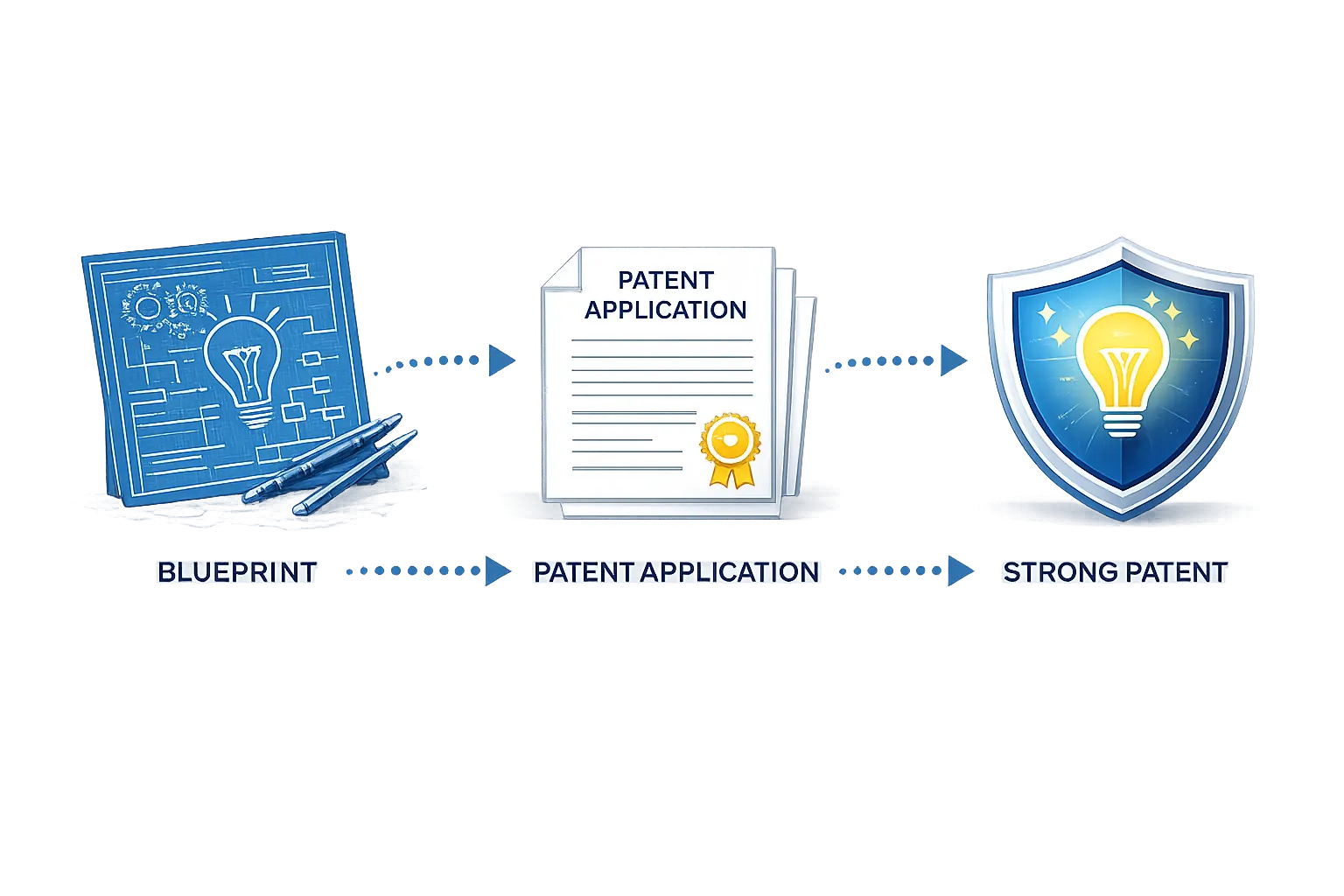
A patent application is much more than a legal document—it is the foundation of your future patent rights. The quality of your patent application can directly impact the strength, scope, and long-term value of any patent that ultimately issues.
Whether you prepare your own application, use an AI-powered patent drafting platform, or hire a patent attorney, understanding what makes a patent application "high quality" can help you make better decisions and avoid costly mistakes.
For a broader explanation of how AI can be used to develop, draft, and refine patent applications, see our AI Patent Drafting: The Complete Guide.
Why Patent Quality Matters
A patent application generally cannot be expanded after it is filed, as the USPTO has strict rules under 35 U.S.C. § 132 and MPEP 2163, prohibiting "new matter" from being added to an application after it is filed. While claims can often be amended during prosecution, such amendments must be supported by the originally filed disclosure and will be rejected if they encompass new subject matter that was not included in the original filing.
A high-quality patent application can help:
- Support a broader range of patent claim amendments
- Provide flexibility during patent prosecution
- Reduce the likelihood of written description and enablement issues
- Overcome patent-eligibility obstacles under 35 U.S.C. § 101
- Better protect against design-arounds by competitors
- Increase the long-term value of your intellectual property portfolio
- Provide support for filing new sets of claims in continuation applications
Conversely, a poorly prepared application may leave important aspects of the invention unprotected, making it easier for competitors to avoid infringement or limiting opportunities to pursue broader claims in future continuation applications.
High-Quality vs. Weak Patent Applications
Not all patent applications provide the same level of protection. The table below highlights key differences between a high-quality patent application and one that may unnecessarily limit the scope and long-term value of a patent.
| High-Quality Patent Application | Weak Patent Application |
|---|---|
| Complete and comprehensive technical disclosure | Omits important aspects of the invention |
| Explains both what the invention does and how it works | Describes the invention primarily in broad, functional terms |
| Describes multiple embodiments and alternative implementations | Focuses on a single embodiment or implementation |
| Covers complementary features and foreseeable variations | Protects only the inventor's current product |
| Supports multiple claim strategies | Provides limited support for future claim amendments |
| Includes strategic drawings supporting the disclosure | Contains minimal or incomplete drawings |
| Tailored to the specific technology | Uses a generic, one-size-fits-all drafting approach |
| Considers future technology trends and applications | Focuses only on today's technology and market |
| Anticipates competitor design-arounds | Leaves opportunities for competitors to easily avoid infringement |
| Provides a strong foundation for continuation applications | Limits future continuation opportunities |
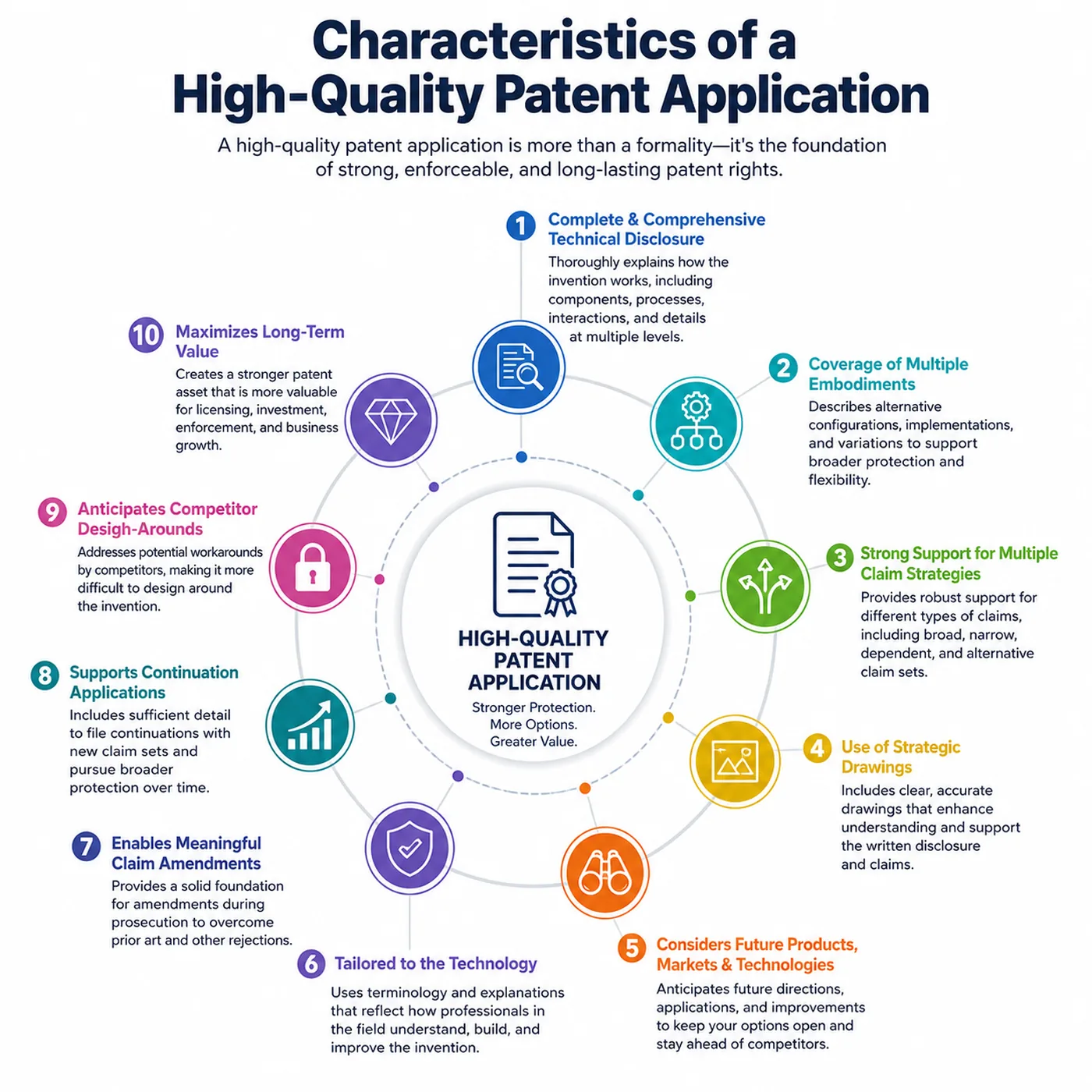
Characteristics of a High-Quality Patent Application
1. A Complete & Comprehensive Technical Disclosure
Perhaps the single most important characteristic of a high-quality patent application is the completeness of its technical disclosure. As a general rule, the more relevant technical detail included in the application, the better. Once a patent application is filed, new technical subject matter generally cannot be added later. As a result, information omitted from the original filing may permanently limit the scope of patent protection that can ultimately be obtained.
A strong patent application should thoroughly explain how the invention works—not merely what it does. The application should explain the underlying implementation, components, processes, interactions, algorithms (where applicable), and other technical details necessary for someone skilled in the field to make and use the invention.
Importantly, the disclosure should describe the invention at multiple levels of abstraction—both broader inventive concepts and lower-level implementation details. This layered approach provides greater flexibility during patent prosecution by supporting a wider range of claim amendments if prior art is encountered.
2. Coverage of Multiple Embodiments
Many inventions can be implemented in numerous ways. A high-quality patent application should not be limited to describing only a single preferred embodiment or the specific product that has been built. Instead, it should disclose multiple embodiments, alternative configurations, architectures, implementations, and variations of the invention whenever appropriate.
Describing multiple embodiments provides several important advantages: it makes it more difficult for competitors to avoid infringement, supports broader claim strategies during prosecution, and provides support for continuation applications directed to alternative aspects of the invention.
The goal is not simply to describe what has been built today, but to protect the broader inventive concepts underlying the invention. By capturing multiple ways of implementing those concepts, a patent application can provide more durable and valuable patent protection over the long term.
3. Strong Support for Multiple Claim Strategies
Patent claims define the legal scope of protection. However, patent claims are rarely finalized when a patent application is first filed—they often evolve throughout the patent examination process and may continue to evolve in later continuation applications. For this reason, a high-quality patent application should provide robust support for a variety of potential claim strategies.
In practice, the vast majority of patent applications (over 90%) receive one or more prior art rejections during examination. Successfully overcoming these rejections often requires amending the claims to distinguish the invention from the cited prior art. A comprehensive technical disclosure provides significantly greater flexibility when responding to these rejections.
Ultimately, a well-drafted specification is an investment in future flexibility. While the claims may change over time in response to prior art, market developments, or evolving business objectives, the original disclosure establishes the foundation upon which those future claim strategies are built.
4. Anticipation of Competitor Design-Arounds
A high-quality patent application does more than describe the inventor's preferred implementation—it anticipates how competitors may attempt to design around the invention. By identifying foreseeable alternatives and including them in the specification, the application can support broader patent claims and reduce opportunities for competitors to avoid infringement through only minor modifications.
Weak patent applications often describe only a single embodiment or implementation, leaving gaps that competitors can exploit. In contrast, stronger applications disclose alternative structures, configurations, components, processes, and optional features that achieve substantially the same result.
For example, a software invention might describe multiple algorithms or architectures that perform the same functionality. A mechanical invention may disclose alternative materials, shapes, connection mechanisms, or manufacturing techniques. These additional embodiments help create a more robust disclosure that supports broader claim strategies during patent prosecution and enforcement.
Why it matters: Anticipating reasonable design-arounds during drafting increases the likelihood that valuable alternatives are protected from the outset, rather than requiring additional filings later.
5. Strategic Drawings Supporting the Invention
Patent drawings are more than illustrations—they form an important part of the patent disclosure and can provide critical support for both current and future patent claims. The drawings should illustrate the subject matter that is, or may later become, part of the claimed invention, including other embodiments, components, processes, and features described throughout the specification.
Software and computer-implemented inventions may include system architecture diagrams, network diagrams, process flowcharts, data flow diagrams, and user interface illustrations. Mechanical and physical product inventions may include perspective views, exploded views, cross-sectional illustrations, electrical schematics, and hardware architectures. Well-prepared drawings make a patent application easier to understand and help ensure that the disclosure provides a strong foundation for protecting the full scope of the invention.
6. Well-Drafted Patent Claims
Patent claims define the legal scope of protection afforded by a patent. While a provisional patent application generally does not require formal claims, including one or more claims is often beneficial—they can help identify the core inventive concepts, reinforce the written description, and ensure that important aspects of the invention are expressly addressed.
In a non-provisional patent application, well-drafted claims become critically important. Effective patent claims should be carefully drafted to capture the invention as broadly as reasonably possible while remaining distinguishable from the prior art. Claims that are drafted too narrowly may provide only limited protection; claims drafted too broadly may be rejected.
The appropriate claim strategy also depends on the technology. Software and AI inventions must satisfy the patent-eligibility requirements of 35 U.S.C. § 101, requiring claim drafting to address both the relevant technology and the applicable legal standards.
7. Tailored to the Technology
High-quality patent applications are not all drafted the same way. The content, level of technical detail, organization, terminology, and drawings should be tailored to the specific technology being protected. What constitutes a strong patent application for a software invention can differ significantly from what is expected for a medical device, mechanical system, pharmaceutical composition, or chemical process.
A high-quality patent application should be adapted to the underlying technology, reflecting the conventions, level of detail, and technical content that would ordinarily be expected for that particular field of invention. Tailoring the application to the technology helps ensure that the invention is clearly described, properly supported, and positioned for successful patent prosecution.
8. Coverage of Different Applications, Industries, and Use Cases
Many inventors naturally describe their invention only in the context of the product, market, or industry they are currently targeting. However, the underlying inventive concepts may have value across numerous applications, industries, or use cases. A high-quality patent application should identify and describe these broader opportunities whenever appropriate.
A patent application should not simply protect what you are doing today—it should also help protect where your invention may be used tomorrow. Thinking broadly about potential applications and industries can significantly increase the long-term value and commercial reach of a patent portfolio.
9. Coverage of Complementary Features
A high-quality patent application should describe not only the core invention itself, but also complementary components and features that naturally accompany or enhance the invention. By considering these related aspects during the drafting process, the application can provide broader support for protecting the overall technology.
Including support for complementary features helps create a broader net of protection—supporting claims directed to related improvements, extensions, optional functionality, or integrated systems, and creating additional opportunities for continuation applications directed to different aspects of the technology.
10. Anticipation of Future Technology Trends
A high-quality patent application should not be limited to protecting today's technology. Whenever practical, inventors should consider how their invention, the surrounding technology, and the marketplace may evolve over time. By anticipating future developments, a patent application can often provide broader and more durable protection.
A well-drafted patent application should not simply protect where technology is today—it should also help protect where technology is likely to be tomorrow. By thoughtfully anticipating future trends, inventors can create patent applications that remain valuable as markets and technologies continue to evolve.
Quality Considerations: Provisional or Non-Provisional Patent Applications
Many inventors assume that because provisional patent applications are never examined by the USPTO, they do not need to be as detailed as non-provisional applications. In reality, the opposite is often true.
Although provisional applications generally do not require formal patent claims or formal patent drawings, they establish the technical disclosure that supports any later-filed non-provisional application claiming priority to the provisional filing. If important subject matter is left out of the provisional application, it may be too late to fix the problem later.
Whether filing a provisional or non-provisional patent application, the quality of the underlying disclosure remains the foundation of a strong patent.
If you are earlier in the process, our step-by-step guide to patenting an idea explains the broader path from developing an invention through filing and USPTO examination.
Once a patent application is filed, the invention may be described as patent pending while the application remains pending. Learn more about what that status means, how long it lasts, and what protection it does—and does not—provide in our Patent Pending Guide.
Before choosing a filing approach, you can also use our provisional patent cost calculator to estimate common drafting and filing expenses.
Common Drafting Mistakes
Even groundbreaking inventions can be supported by weak patent applications that unnecessarily limit the scope and value of the resulting patent. Many weak patent applications suffer from one or more of the following issues:
- ●Single Embodiment Focus – Focusing on just one implementation can unnecessarily limit future claim strategies and make it easier for competitors to design around the invention.
- ●Few or no alternative implementations – Failing to describe different architectures, configurations, or approaches may reduce flexibility during patent prosecution and continuation practice.
- ●Narrow descriptions tied too closely to a single product or industry – Describing the invention only in the context of its current commercial implementation may unnecessarily limit protection in future markets or applications.
- ●Failure to anticipate future developments – Not considering emerging technologies, evolving markets, or future product enhancements can reduce the long-term value and adaptability of the patent.
- ●Failure to consider how competitors might design around the invention – A narrow disclosure may allow competitors to avoid infringement by making relatively minor changes or substituting equivalent components.
- ●Failure to Address Technology-Specific Requirements – The application fails to include the types of technical disclosures typically expected for the particular technology. For example, software inventions may not adequately describe the technical implementation or technical improvements needed to address patent eligibility under 35 U.S.C. § 101.
- ●Poorly Drafted Patent Claims – While formal claims are generally much less important in a provisional patent application, they are critical in a non-provisional application. Claims that are drafted too narrowly may provide significantly less patent protection than the applicant is entitled to obtain.
Fortunately, many of these weaknesses can be identified and addressed before filing. Taking the time to prepare a complete, strategic, and forward-looking patent application can significantly improve the strength, flexibility, and long-term value of your patent rights.
Can AI Draft a High-Quality Patent Application?
Yes—but the quality of the resulting patent application depends heavily on the AI tool being used.
General-purpose AI tools typically generate text based only on the information provided by the user. While they can help draft portions of a patent application, they often do not identify missing technical details, suggest additional embodiments, recommend complementary features, or guide inventors through developing a more complete invention disclosure.
The most capable AI patent drafting platforms do far more than simply draft patent applications—they help inventors prepare stronger patent applications. However, the capabilities of AI patent drafting platforms vary considerably, so be sure to do your research before selecting one to protect your invention. Regardless of whether AI is used, inventors should carefully review the resulting patent application to ensure it accurately describes the invention and fully captures the scope of the innovation.
How Idea2PatentAI Helps Inventors Prepare High-Quality Patent Applications
Idea2PatentAI was designed around a simple principle:
A stronger patent application begins with a more complete invention disclosure.
Instead of asking users to draft a patent application themselves, Idea2PatentAI guides inventors through a structured invention development process that helps identify important technical details before the patent application is generated.
- →Comprehensive Applications: Generates a complete provisional application with USPTO-compliant sections. On average, users can expect to receive an application that is 35–55 pages in length.
- →Technology-Specific Detection & Adaptation: Detects the technology area and automatically adapts the application content to satisfy technology-specific requirements.
- →AI Invention Disclosure Enhancement: Automated analysis of invention details to identify missing, vague, or incomplete aspects—and specific recommendations for strengthening the disclosure.
- →AI-Powered Recommendations to Bolster Protection: Analyzes invention details and suggests new embodiments, applications, features, and future trends that may have been overlooked by inventors.
- →Optional Attorney Review: Users can connect with a registered patent attorney via the Attorney Referral Network to review, supplement, and/or file their application.
The goal is not to replace patent attorneys, but to help inventors prepare more complete, higher-quality patent applications while significantly reducing cost and complexity.
Frequently Asked Questions
Can a patent application be improved after filing?
While patent claims can often be amended during examination, new technical subject matter generally cannot be added after filing. For this reason, preparing a complete application before filing is extremely important.
Do provisional patent applications need to be high quality?
Yes. Although provisional patent applications are never examined, they establish the disclosure that later supports a non-provisional patent application claiming priority to the provisional filing.
Is AI capable of drafting a patent application?
Some specialized AI patent drafting tools can generate high-quality draft patent applications when provided with sufficient information. However, the quality of the final application depends heavily on the platform.
Continue Learning About Patent Drafting
If you'd like to learn more about preparing strong patent applications, the following guides provide additional information on provisional patent applications, AI-assisted patent drafting, filing strategies, and common inventor mistakes.
- →AI Patent Drafting: The Complete Guide
- →Provisional Patent Application Requirements for Software, Algorithms & MVPs (DIY Guide)
- →Writing Patents with AI: What Works (and What Doesn't)
- →Best AI Patent Drafting Tools (2026): Complete Guide & Comparison
- →Provisional Patent Application Example: A Complete Walkthrough
- →Filing a Provisional Patent Application Pro Se: Common Inventor Mistakes
- →Provisional Patent Application Template: What to Use (and What to Avoid)
- →AI Patent Drafting vs. Traditional Patent Attorneys: Which Is Right for You?
Ready to Prepare Your Patent Application?
Whether you're filing your first provisional patent application or evaluating AI patent drafting tools, understanding what makes a high-quality patent application is the first step toward protecting your invention.
Learn how Idea2PatentAI helps inventors prepare more complete patent applications while reducing the cost and complexity of the drafting process.
Get Started Free →By: Idea2PatentAI Editorial Team | Reviewed by: U.S. Patent Attorney | Last updated: August 2026
Editorial Standards
This guide was prepared by the Idea2PatentAI editorial team and reviewed for technical and legal accuracy by a U.S. patent attorney. It is provided for educational purposes only and does not constitute legal advice. Reading this guide or using Idea2PatentAI does not create an attorney-client relationship.
We aim to keep our content accurate and current; however, patent laws, regulations, USPTO fees, and USPTO practices can change. If you believe this page contains an error, please contact us. For more information about our content standards, see our Editorial Policy.