AI Patent Drafting Guide
AI Patent Drafting: The Complete Guide
Learn what AI patent drafting is, how it works, where AI can improve the patent-drafting process, and what to consider when choosing an AI patent drafting tool to help prepare a patent application.
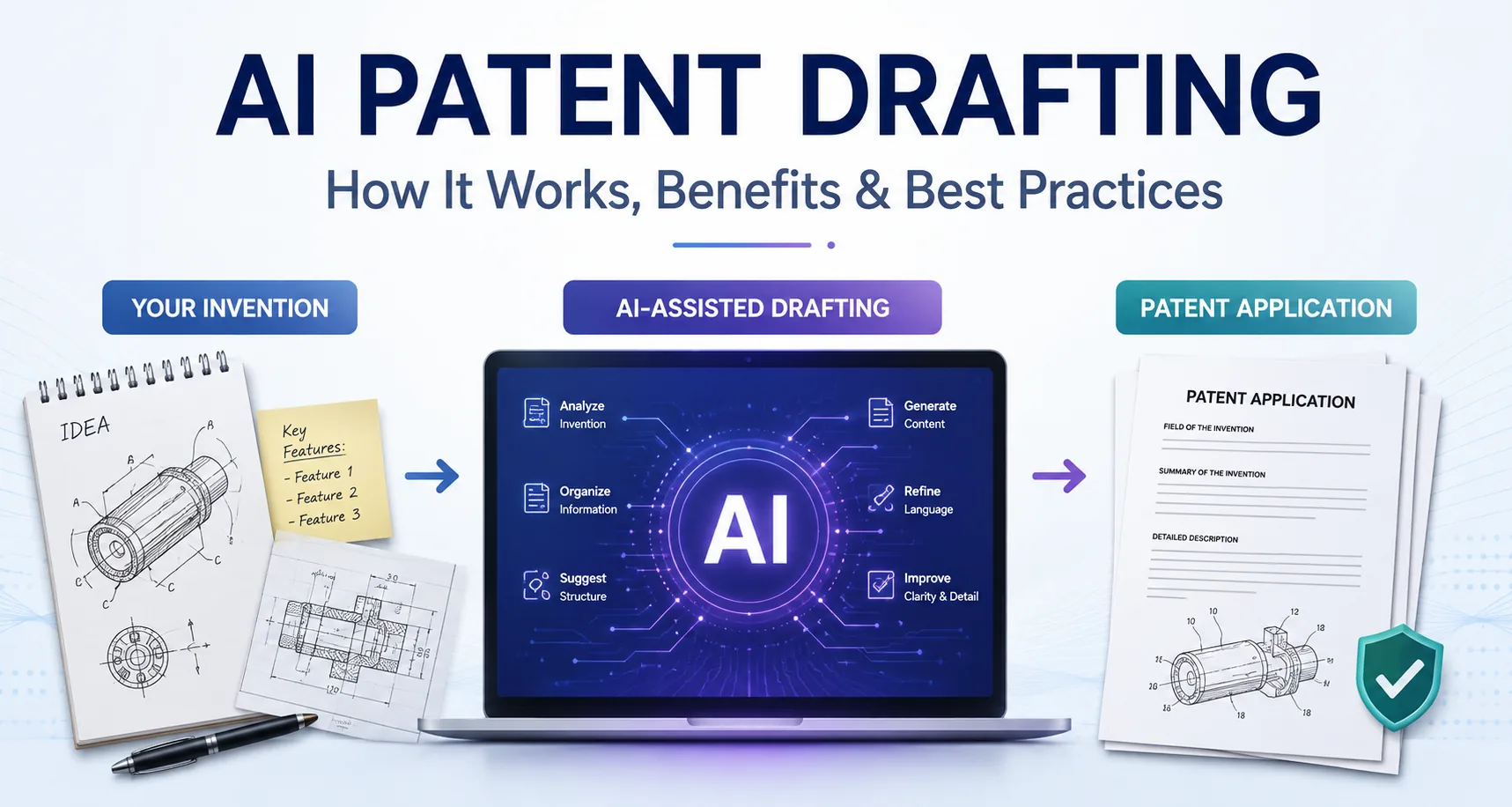
AI patent drafting uses artificial intelligence to help develop, prepare, and refine patent applications. Whether you're preparing a provisional or non-provisional application, AI can assist with organizing invention information, identifying details that may need further development, generating portions of a patent application, drafting or refining claims, and reviewing an existing patent draft.
But patent drafting with AI involves much more than asking a chatbot to "write a patent."
A patent application is not simply a technical description written in formal language. It may ultimately serve as the foundation to support patent claims covering different aspects of an invention. Important technical details, alternative embodiments, implementation options, and other subject matter omitted from the original application may be impossible to add later while retaining the original filing date. U.S. patent law prohibits introducing new matter into an application after filing, and the USPTO applies this restriction to amendments that attempt to add disclosure not supported by the application as originally filed. See 35 U.S.C. § 132 and MPEP § 2163.06.
For that reason, effective AI-assisted patent drafting depends not only on the language model generating the text, but also on the process used to gather, develop, organize, and review the underlying invention disclosure.
This guide explains how AI patent drafting works, what AI can help with during the drafting process, its benefits, limitations and risks, how general-purpose AI differs from patent-specific AI, and best practices for using AI to prepare stronger patent application drafts.
What Is AI Patent Drafting?
AI patent drafting is the use of artificial intelligence to assist with preparing some or all of a patent application. Depending on the tool and workflow, AI may be used for relatively simple writing tasks or may assist throughout much of the patent-drafting process.
At the simplest level, an inventor or patent professional might provide a general-purpose AI model with a description of an invention and ask it to draft a section of a patent application.
More sophisticated AI patent drafting systems can provide a structured workflow that helps develop the invention disclosure before the full application is generated. These systems may ask patent-specific questions, identify potentially missing information, help develop alternative implementations, organize technical details, generate different sections of the application, and provide tools for reviewing and refining the resulting draft.
The term AI patent drafting therefore covers a range of approaches rather than a single type of technology.
AI-Assisted vs. Automated Patent Drafting
AI patent drafting can generally be thought of as a spectrum. Different AI patent drafting tools provide different levels of automation and may require very different levels of patent-drafting knowledge from the user.
At one end are AI-assisted patent drafting tools, many of which are designed for patent attorneys and other experienced patent practitioners. These tools often function as an AI patent writing assistant that works alongside the practitioner. For example, the user may prompt the AI agent to draft or revise particular sections, develop claims, analyze existing disclosure, or suggest additional content with specific instructions based on the practitioner's professional judgement. Because the user is expected to understand patent drafting, these systems can rely more heavily on the practitioner to determine what information should be provided, what questions should be asked, and what the resulting application should contain.
At the other end are more automated AI patent drafting tools, particularly those designed for inventors, entrepreneurs, and other users who may have little or no patent-drafting experience. These systems generally need to provide more of the patent-specific structure and guidance that an experienced patent practitioner would otherwise supply.
The sophistication of these systems can vary considerably. A relatively simple approach may ask the user to provide a description of the invention and then use AI to generate a patent application from that information.
More sophisticated systems can incorporate an invention-development stage before generating the full application, followed by AI-assisted editing tools that help refine the initial draft produced by the system. For example, before drafting begins, AI may help the user develop important technical details, identify missing or underdeveloped information, consider potential competitor design-arounds, explore alternative embodiments and variations, and otherwise strengthen the underlying invention disclosure. After the initial application is generated, AI-assisted editing tools may then help expand particular sections, clarify technical descriptions, add further embodiments or details, revise claims, and otherwise refine the draft before it is finalized.
This distinction is important because greater automation does not necessarily produce a better patent application. The quality of the resulting patent application will depend heavily on the quality and completeness of the underlying invention information, the patent-specific capabilities of the system, and the process used to develop and review the application.
What AI Patent Drafting Is Not
AI patent drafting should not be viewed simply as a way to convert a short invention summary into patent-style language or a standard patent application format.
This approach tends to produce a document that looks and sounds like a patent application while often omitting key information that should be included in the patent application.
For example, using a general-purpose AI model or a lower-quality drafting tool that simply generates an application from a basic invention summary may fail to adequately address:
- important technical details underlying how the invention works;
- alternative ways of implementing the invention;
- optional components or features;
- different system architectures;
- variations that a competitor could use;
- different applications or use cases;
- subject matter that may later be needed to support patent claims.
AI can help address many of these issues, but the drafting tool and workflow need to be designed to identify and develop them rather than simply generate patent-style text from the information initially provided.
Why Patent Drafting Is Different From Ordinary AI Writing
Large language models (LLMs) are particularly effective at generating and reorganizing text. Patent drafting, however, is not solely a writing exercise.
The ultimate objective is not merely to produce a polished description of an invention. A patent application should provide a technical disclosure capable of supporting the patent protection the applicant may later seek. Under 35 U.S.C. § 112(a), the specification must contain a written description of the invention and describe how to make and use it with sufficient detail to enable a person skilled in the art to do so. Section 112(b) separately requires claims that particularly point out and distinctly claim the subject matter regarded as the invention. See 35 U.S.C. § 112.
This distinction is critical.
An inventor may initially describe an invention using only the version currently being developed or sold by the inventor. A strong patent application may need to look beyond that single implementation and consider broader inventive concepts, lower-level implementation details, alternative configurations, complementary features, additional applications, and foreseeable variations.
For example, suppose an inventor develops a new software platform and explains its primary user interface and intended workflow. Those details may be useful, but a patent application may also need to describe the system architecture, processing performed by different components, data flows, algorithms or logic, alternative architectures, technical improvements, and other ways the same underlying concepts could be implemented.
Similarly, an inventor describing a mechanical product may naturally focus on the particular materials, dimensions, connectors, and configuration used in the current prototype. Patent drafting may require consideration of alternative structures, materials, connection mechanisms, component arrangements, and other embodiments that accomplish the same underlying objective.
This is one reason why understanding what makes a high-quality patent application is useful before evaluating any AI drafting system.
AI can accelerate the writing process. The more difficult question is whether the drafting process helps capture the invention comprehensively enough to support meaningful patent protection.
How Does AI Patent Drafting Work?
There is no single AI patent drafting workflow. Different tools provide very different levels of guidance, automation, and user control.
A well-structured process, however, will often include several stages.
1. Gathering Information About the Invention
Every patent application begins with information about the invention. That information might come from:
- an invention disclosure form;
- written notes;
- product documentation;
- technical specifications;
- diagrams or drawings;
- software architecture descriptions;
- process flows;
- conversations with inventors;
- prototype information;
- existing technical materials.
With a general-purpose AI tool, the user typically decides what information to provide and how to present it.
Patent-specific systems may instead guide the user through a structured set of questions designed to obtain information commonly needed for patent drafting.
The distinction can be significant because inventors do not always know which details could become important during patent prosecution.
2. Developing and Organizing the Invention Disclosure
Once the initial invention information has been collected, AI can potentially help organize and develop it before the application is drafted. Depending on the system, this may include identifying:
- aspects of the invention that are described only at a high level;
- components whose operation is unclear or ambiguous;
- relationships between system elements that need further explanation;
- steps in a process that have not been fully described;
- potentially important technical details that have not yet been addressed;
- alternative embodiments or implementations;
- additional use cases or applications;
- complementary features;
- foreseeable variations.
This stage can be particularly valuable.
If the underlying invention disclosure is incomplete, simply generating additional patent-style language may not solve the problem. The system may instead expand upon the same incomplete information.
A more useful approach is often to identify weaknesses in the invention disclosure before generating the final draft. Indeed, this mirrors an important part of the traditional patent-drafting process: a patent attorney will typically review the invention information provided by the client and solicit additional details to clarify ambiguities, fill in gaps, and more fully develop the disclosure before preparing the application.
3. Drafting the Patent Application
After the invention information has been sufficiently developed, AI can assist with generating patent-application content. Depending on the application type and drafting system, AI may assist with sections such as:
- the title;
- technical field;
- background;
- summary;
- brief description of the drawings;
- detailed description;
- patent claims;
- abstract.
AI can also help maintain terminology and organization across the application.
For example, if a component is introduced using one name, an AI drafting system may help use consistent terminology when describing that component elsewhere. Similarly, the system may help organize the detailed description so that different embodiments are presented logically.
Regardless of whether the application is prepared using an automated patent drafting system or by a traditional patent attorney, the inventor should still carefully review the disclosure for accuracy and completeness. The inventor is often in the best position to identify technical inaccuracies, missing details, or aspects of the invention that have not been fully described.
4. Reviewing and Refining the Draft
Review is an important part of AI-assisted patent drafting. The inventor should confirm that the draft accurately reflects the invention. Depending on the circumstances, the application may also be reviewed by a patent attorney or patent agent.
AI itself can also assist with the refinement process. For example, more sophisticated patent drafting systems may include an editing environment with AI-assisted tools that can help:
- expand particular technical explanations;
- incorporate user-specified micro or global document edits;
- suggest additional embodiments;
- assess whether particular concepts are adequately described;
- revise claims; and
- improve the organization of the draft.
This iterative approach is discussed in greater detail in Writing Patents with AI: What Works (and What Doesn't).
In many cases, the most effective use of AI is not a single prompt followed by a finished application. It is a multi-stage process in which the invention disclosure and resulting draft are progressively developed and refined.
What Can AI Help With During Patent Drafting?
AI can assist with numerous patent-drafting tasks. The capabilities vary significantly between general-purpose language models and specialized patent-drafting systems, but several applications are particularly relevant.
Organizing Invention Information
Inventors frequently describe inventions in a nonlinear manner. They may discuss the main concept, jump to a specific technical feature, return to the overall system, describe a potential commercial application, and then introduce another variation. AI can help organize this information into logical categories and identify relationships between different aspects of the invention. That organizational assistance can make it easier to determine which portions of the invention have been thoroughly described and which areas require additional development.
Identifying Missing or Underdeveloped Details
One potentially valuable use of AI is analyzing an invention disclosure for areas that appear vague, incomplete, or underdeveloped. For example, a description may state that one component "analyzes the data" without explaining:
- which data is analyzed;
- where the data originates;
- what processing is performed;
- what information results from the analysis;
- how the resulting information affects subsequent system operation.
A drafting workflow can prompt the inventor to develop those details before the application is generated. This does not guarantee that every relevant omission will be discovered. But a structured review can be substantially more useful than assuming the inventor's first description contains everything that should be included.
Exploring Variations and Alternative Embodiments
Inventors naturally tend to focus on their preferred implementation. AI can help brainstorm reasonable alternatives. For example, it may prompt consideration of:
- different component configurations;
- alternative materials;
- substitute algorithms;
- different communications architectures;
- optional system elements;
- alternative process sequences;
- different user environments;
- additional applications or industries;
- foreseeable modifications.
Not every suggested variation or alternative embodiment belongs in a patent application. The inventor should evaluate each possibility rather than automatically incorporating AI-generated suggestions. Used carefully, however, AI can help broaden the inventor's thinking beyond the particular version of the invention being built today.
Developing Technical Descriptions
AI can help transform notes or informal descriptions into more structured technical explanations. This may be useful when the inventor understands the technology but has difficulty translating that understanding into a detailed written description. For example, AI may help explain relationships between system components, describe sequences of operations, expand an algorithm description, or organize a mechanical process into a series of steps. The important limitation is that AI cannot reliably supply technical information that the inventor has not actually developed. If the AI model attempts to fill gaps by inventing missing details rather than obtaining or developing them with the inventor, the resulting application may inaccurately or incompletely describe the invention. More sophisticated AI patent drafting tools can help mitigate this risk by identifying deficiencies in the invention disclosure and prompting the inventor for additional information—or, where appropriate, recommending potential details or variations for the inventor to consider and confirm.
Preparing Patent Application Sections
AI is particularly well suited to transforming a developed invention disclosure into organized sections of a patent application. The model can take the same underlying technical information and express it differently depending on the function of the section. For example:
- the summary may present a broader overview of the invention and its features;
- the detailed description may provide implementation detail and multiple embodiments;
- the abstract may provide a concise technical overview;
- the claims may attempt to define particular combinations of elements or steps.
The ability to reuse a developed invention disclosure across different sections can reduce repetitive manual drafting.
Assisting With Patent Claims
While general-purpose AI models often lack the patent-specific knowledge needed to draft high-quality claims, specialized AI patent drafting systems can incorporate claim-drafting principles and expert guidance to provide more effective assistance with claim preparation. Potential uses include:
- drafting initial claim sets;
- generating different claim formats;
- adapting claim language and claim types to technology area;
- suggesting dependent claims;
- identifying terminology inconsistencies;
- helping map claim elements to the specification;
- exploring alternative claim structures.
Claim drafting requires particular care because patent claims define the legal scope of protection. Small differences in wording, claim structure, or the relationship between claim elements can materially affect the scope and effectiveness of the resulting claims.
The USPTO explains that patent claims define the boundaries of the subject matter protected by the patent and must be sufficiently definite to inform the public of those boundaries. See MPEP § 2173 – Claims Must Particularly Point Out and Distinctly Claim the Invention. For that reason, effective AI-assisted claim drafting generally requires more than a system that can simply generate patent-style language. A more sophisticated system should be designed around patent-specific claim-drafting principles and expert guidance so that it can account for issues such as claim scope, support in the specification, alternative claim formulations, and the relationship between independent and dependent claims.
Reviewing and Refining an Existing Draft
AI is not limited to generating new material. It can also help refine an existing patent draft by identifying passages that may require further explanation, rewriting unclear language, checking for inconsistent terminology, or helping the user develop additional embodiments. For some users, this may be a more effective use of AI than asking the system to generate an entire application from scratch.
Why the AI Patent Drafting System You Choose Matters
Not all AI patent drafting systems provide the same level of guidance or patent-specific functionality. General-purpose AI models and less sophisticated patent drafting tools may be capable of generating a document that looks like a patent application, but they can fall short in areas that are important to the quality and completeness of the resulting disclosure.
More sophisticated AI patent drafting systems can be designed to address many of these limitations through structured invention-development workflows, patent-specific guidance, technology-specific analysis, and tools for reviewing and refining the resulting draft.
Identifying Missing or Underdeveloped Invention Details
A common weakness of simpler AI drafting approaches is that they primarily work with the information initially supplied by the user. This can be problematic when the invention is described mainly in terms of its desired result rather than how the invention actually accomplishes that result.
For example: "The system uses AI to identify fraudulent transactions."
That statement describes the intended functionality but provides relatively little information about how the system operates. A stronger disclosure may need additional information concerning the inputs, model architecture or analytical process, feature generation, data processing, decision criteria, system components, output generation, and technical implementation.
A more sophisticated AI patent drafting system can help address this issue by analyzing the initial invention disclosure, identifying areas that appear vague or underdeveloped, and prompting the inventor to provide additional information before the application is generated. The inventor nevertheless remains an essential source of the underlying technical information. The goal of the AI system should be to help identify and develop missing details—not simply invent technical information to fill gaps in the disclosure.
Avoiding Incorrect or Unsupported Technical Information
General-purpose AI models can sometimes generate plausible-sounding information that is inaccurate or unsupported by the inventor's actual technology. This risk can become particularly important in patent drafting because a polished technical explanation may appear credible even when it does not accurately describe the invention.
More sophisticated patent drafting systems can help reduce this risk by incorporating guardrails that ground the drafting process in information supplied or confirmed by the inventor and by providing opportunities to review and refine the generated disclosure. Regardless of the system used, the inventor should carefully review important aspects of the resulting application, including:
- technical descriptions;
- relationships between components;
- algorithms and processes;
- generated examples;
- terminology; and
- other details concerning how the invention operates.
Incorporating Patent-Specific Drafting Guidance
Patent drafting involves considerations that extend beyond ordinary technical writing. For example, a drafting process may need to consider:
- which inventive concepts should be emphasized;
- whether important embodiments and variations have been described;
- whether the disclosure supports different potential claim formulations;
- whether important technical details have been omitted;
- whether foreseeable competitor design-arounds should be addressed; and
- whether the application provides sufficient support at both broader conceptual and more detailed implementation levels.
A general-purpose AI system typically relies heavily on the user to recognize these issues and provide the appropriate instructions. Some of the more sophisticated patent-specific AI drafting systems can instead incorporate patent-drafting principles and expert guidance into the workflow itself, helping users address issues they may not otherwise know to consider.
Adapting the Drafting Process to the Technology
Different technologies can require very different types of supporting disclosure. A strong patent application for a software invention does not necessarily contain the same types of details as an application directed to a mechanical device, electrical circuit, chemical composition, or medical technology.
For example, a software application may benefit from detailed treatment of system architecture, processing logic, data flows, algorithms, model operation, and technical improvements. A mechanical invention may instead require detailed discussion of physical structures, geometries, connections, movement, materials, and alternative component configurations.
A generic drafting process that treats every invention in essentially the same manner may overlook these technology-specific considerations. More sophisticated AI patent drafting systems can adapt the invention-development and drafting process based on the technology involved, helping identify the types of details that may be particularly important for that invention.
Ultimately, the usefulness of AI patent drafting depends on more than the ability to generate patent-style text. The quality of the resulting application will depend heavily on the quality and completeness of the underlying invention information, the patent-specific capabilities of the system, and the process used to develop, draft, and review the application.
For a deeper discussion of software inventions, see our guide to provisional patent application requirements for software, algorithms, and MVPs.
General-Purpose AI vs. Patent-Specific AI
Not all AI patent drafting approaches are the same. One of the most important distinctions is between general-purpose AI models and AI systems specifically designed for patent drafting.
General-Purpose AI Tools
General-purpose models such as ChatGPT, Claude, and Gemini can be highly capable writing and reasoning tools. They can assist with tasks such as:
- brainstorming;
- organizing invention notes;
- rewriting technical material;
- drafting individual patent sections;
- generating questions;
- developing examples;
- reviewing text;
- generating preliminary claims.
Their flexibility is one of their greatest strengths. But general-purpose AI typically relies on the user to determine what questions should be asked and what information should be supplied. An experienced patent professional may know to ask the model to explore alternative embodiments, develop additional implementation detail, review claim support, identify possible design-arounds, or tailor the disclosure to a particular technology. An inventor with little patent experience may not know that those questions should be asked.
For a detailed discussion of this issue, see Can ChatGPT Write a Patent Application? Pros & Risks.
Patent-Specific AI Systems
Patent-specific AI systems can incorporate patent-drafting considerations into the workflow itself. Depending on the platform and intended user, this might include:
- structured invention intake with technology-specific questions;
- analysis for missing or vague information;
- technology-specific drafting;
- development of embodiments and variations;
- specialized claim tools;
- section-specific generation;
- patent-specific editing or review functions.
Some platforms are designed primarily for patent attorneys and law firms. Others are designed for inventors or businesses preparing applications without having an attorney perform every stage of drafting. The appropriate system therefore depends partly on who will use it and what role the AI is expected to perform.
Neither Approach Is Automatically Better for Every User
General-purpose AI can be extremely useful in the hands of someone who understands patent drafting and can effectively direct the model. A specialized system may provide more value to individuals who need the drafting workflow itself to help supply patent-specific guidance they lack.
Similarly, a patent attorney may value tools that integrate with professional prosecution workflows, while an inventor may prefer a system that explains the process in plain language and provides more structured guidance.
The relevant question is not simply: Which AI model is smartest?
A better question is: Does the overall workflow help the user develop and prepare the type of patent application needed for the particular invention?
For comparisons of specific products and platforms, see our Best AI Patent Drafting Tools guide.
What Makes AI-Assisted Patent Drafting Effective?
The quality of an AI-assisted patent application depends on much more than the amount of text generated. A better drafting process focuses on developing the underlying invention disclosure before and during generation.
Start With a Well-Developed Invention Disclosure
AI works best when it has substantive information to work with. A short explanation such as "My invention uses AI to improve inventory management." is usually not enough to support a meaningful technical disclosure. Useful additional information might include:
- system components;
- data inputs;
- processing steps;
- communications between components;
- algorithms or decision logic;
- outputs;
- user interactions;
- technical improvements;
- alternative configurations;
- specific examples.
The exact information needed will depend on the invention. The goal should be to give the drafting system enough substance to accurately describe how the invention works, not merely what the invention is intended to accomplish.
Identify Gaps Before Generating the Full Draft
A common mistake is to move directly from invention summary to application generation. If important details are missing from the input, the generated patent application may simply present those same gaps in more polished language. A stronger workflow includes an intermediate stage in which the invention disclosure is evaluated. Questions might include:
- Which aspects are still described only functionally?
- Are important components unexplained?
- Are relationships between components clear?
- Are there multiple ways the invention could be implemented?
- Are there important optional features?
- What might a competitor change while preserving the core concept?
- Are relevant use cases missing?
- Does the disclosure address details expected for the particular technology?
Develop Alternative Embodiments and Variations
A patent application generally should not be unnecessarily limited to a single implementation. Suppose an invention uses a sensor connected wirelessly to a mobile device. If the inventor's current prototype uses Bluetooth, the application may describe Bluetooth in detail. But if Wi-Fi, NFC, cellular communication, wired communication, or another communication mechanism could also be used, describing appropriate alternatives may provide additional flexibility. The same principle applies throughout an invention. AI can help prompt the inventor to consider reasonable alternatives, but the inventor should confirm that suggested embodiments are technically realistic and consistent with the invention.
Adapt the Disclosure to the Technology
Different technologies call for different drafting considerations. A useful AI patent drafting workflow should not treat an algorithm, mechanical assembly, electrical circuit, and chemical formulation as interchangeable writing exercises. For software and AI inventions, additional attention may be given to architecture, data processing, algorithms, model operation, system interactions, and technical improvements. For mechanical inventions, physical relationships, movement, geometry, materials, connections, and alternative component configurations may become more significant.
Preserve Support for Different Claim Strategies
It is often difficult to know exactly how patent claims will evolve over the life of an application. Claims may need to change because of prior art discovered during examination, competitor activities in the marketplace, evolving business objectives, newly developed product features, or continuation strategies. For that reason, the specification should ideally provide support for the invention at different levels of detail. A disclosure that describes only the broad idea may lack support for useful narrower claim amendments. A disclosure that describes only one narrow implementation may unnecessarily restrict the range of claim strategies available later. A stronger application attempts to capture both broader inventive concepts and supporting implementation detail.
Review the Application as Technical and Legal Requirements
A final AI-generated draft should not be reviewed merely for grammar and readability. The more important questions include:
- Does it accurately describe the invention?
- Are the important inventive concepts present?
- Are important technical details adequately explained?
- Does the application describe reasonable alternatives?
- Are the claims supported by the specification?
- Has the AI introduced information that is inaccurate?
- Are there important areas that remain vague?
Effective AI patent drafting is not primarily about generating more text. It is about helping develop a more complete, accurate, and useful invention disclosure before and during the drafting process.
For a more extensive discussion of the characteristics that strengthen a patent disclosure, see What Makes a High-Quality Patent Application.
Using AI to Draft a Provisional Patent Application
Provisional patent applications are a common use case for AI patent drafting, particularly among inventors and startups seeking a lower-cost way to establish an initial U.S. filing date.
A provisional application generally has fewer formal requirements than a non-provisional application. But fewer formalities should not be confused with lower disclosure standards.
The value of a provisional application's filing date depends on what the application actually describes and how comprehensively it covers the inventive concept. If important subject matter is omitted from the provisional application and added only to a later non-provisional application, the newly added subject matter may not receive the benefit of the earlier provisional filing date.
The USPTO explains that, for claimed subject matter in a later nonprovisional application to receive the benefit of a provisional application's filing date, the provisional application must adequately support and enable that subject matter in accordance with 35 U.S.C. § 112(a). See MPEP § 211.05 – Sufficiency of Disclosure in Prior-Filed Application.
That makes disclosure quality particularly important. AI can assist by helping inventors:
- organize technical information;
- identify areas requiring further explanation;
- develop embodiments and alternatives;
- draft different sections;
- review and refine the resulting application.
But the inventor should still carefully review the final document and confirm that it accurately and comprehensively describes the invention.
AI Patent Drafting vs. a Patent Attorney
AI patent drafting and patent-attorney drafting should not always be viewed as mutually exclusive choices. Different approaches may make sense depending on:
- the complexity of the invention;
- the inventor's patent experience;
- the commercial importance of the technology;
- budget;
- legal risk;
- the need for claim strategy;
- prior art issues;
- international filing plans;
- whether professional review will be obtained.
Some inventors may feel comfortable using AI to prepare and file an application themselves, particularly where budget is limited or while they evaluate the invention's commercial potential. Other inventors may use AI to prepare an initial draft and then engage a patent attorney for review, supplementation, filing, or strategic advice. Others may prefer attorney involvement from the beginning, particularly to address public disclosure issues, difficult prior art environments, or situations requiring significant legal strategy.
For a detailed comparison of the approaches, see AI Patent Drafting vs. Traditional Patent Attorney Services.
How to Evaluate an AI Patent Drafting Tool
The rapid growth of AI patent drafting has produced tools with very different purposes and capabilities. Rather than selecting a platform based solely on whether it can generate a patent application, consider how the overall workflow handles the invention before, during, and after drafting.
Who Is the Tool Designed For?
Some AI patent tools are designed for experienced patent attorneys. Others are designed for inventors, startups, entrepreneurs, in-house legal teams, patent agents, or law firms. A system built for an experienced patent practitioner may assume knowledge that an independent inventor does not have. Conversely, a simplified inventor-oriented system may not provide the workflow integrations or prosecution features needed by a large patent practice. Start by identifying the intended user.
How Does It Gather Invention Information?
Consider whether the platform simply asks for an invention description or provides a more structured disclosure process. A useful intake workflow may help capture the problem being solved, important system components, operation of the invention, process steps, technical implementation, distinguishing features, alternatives and variations, drawings, and use cases. The quality of the information entering the drafting process can strongly influence the quality of the resulting application.
Does It Help Develop the Invention Disclosure?
Generating a longer patent application is not necessarily the same as generating a more complete one. Consider whether the system identifies potentially missing information, flags vague descriptions, asks follow-up questions, helps develop alternatives, prompts consideration of other embodiments, or encourages additional technical detail. This is one of the more important differences between simple text-generation tools and structured patent-drafting workflows.
Is the Drafting Adapted to the Technology?
Determine whether the system uses essentially the same process for every invention or adapts the drafting to different technology areas. A software invention may require very different supporting material than a mechanical system. Technology-specific guidance can help surface information that a generic drafting process might overlook.
Can the User Review and Edit the Draft?
Patent applications should not be treated as finished merely because the AI has completed generation. Look for the ability to edit content manually, revise individual sections, ask the AI to expand particular topics, preserve previous versions, correct terminology, add new information, and download an editable document. User control is particularly important when AI is being used to prepare a legal and technical document.
How Does the Provider Handle Privacy and Data?
Patent drafting often involves information that has not yet been publicly disclosed. Review the provider's policies concerning data retention, model training, third-party AI providers, deletion, account security, storage, and confidentiality. Avoid assuming that every AI product handles invention information in the same manner.
For comparisons of specific platforms, features, intended users, and workflows, see our Best AI Patent Drafting Tools guide.
Privacy, Confidentiality, and Human Review
Patent applications commonly involve sensitive technical and business information. Before providing confidential invention information to any AI system, users should understand how that information will be handled. Important questions include:
- Is submitted information stored?
- How long is it retained?
- Can the information be deleted?
- Is customer data used to train AI models?
- Who can access stored information?
The answers vary across different platform providers. Inventors and patent professionals should therefore review the privacy terms and data-handling practices of the particular AI tool rather than assuming that all AI platforms provide the same protections.
Human review is equally important. AI-generated patent content, particularly content generated by less sophisticated AI patent drafting systems, may lack appropriate guardrails on generating content, and therefore may contain:
- factual inaccuracies;
- technical misunderstandings;
- terminology inconsistencies;
- unsupported assumptions;
- overly broad statements;
- invented details.
A user should verify the final document before relying on it for a patent filing.
Where appropriate, a registered patent attorney or patent agent can also review the application for legal issues, drafting strategy, claim support, and filing considerations.
AI Beyond Patent Drafting
Patent drafting is only one area in which artificial intelligence is being applied to patent work. The broader category of AI for patents includes several related technologies.
AI for Patent and Prior-Art Searching
AI can assist with searching large collections of patents and technical documents. Modern search systems may use semantic relationships rather than relying entirely on exact keyword matches, potentially helping users locate conceptually similar references even when different terminology is used. Prior-art searching is a specialized subject and involves different tools and search intent from patent drafting.
AI for Patent Drawings
AI is also beginning to assist with patent figures and technical illustrations. Potential applications include generating initial diagrams, converting rough sketches into more polished figures, producing flowcharts, and helping create visual representations of system components. Patent drawings remain subject to particular requirements, so AI-generated figures should be reviewed before filing.
AI for Patent Prosecution
AI can assist after an application has been filed. Potential uses include:
- reviewing Office Actions;
- summarizing examiner rejections;
- analyzing cited references;
- comparing claims with prior art;
- drafting portions of responses;
- researching legal issues;
- reviewing proposed claim amendments.
These activities involve different legal and strategic considerations than preparation of the original application.
AI for Patent Analytics and Portfolio Management
AI can also help analyze larger collections of patent information. Potential uses include:
- competitive patent analysis;
- technology landscape analysis;
- portfolio categorization;
- patent-family analysis;
- identifying trends across technical fields;
- monitoring competitor filings.
These technologies illustrate how much broader the field of AI for patents can be.
This guide focuses specifically on AI patent drafting—the use of AI to help develop and prepare patent applications—but drafting is increasingly becoming one part of a larger AI-assisted patent workflow.
Frequently Asked Questions About AI Patent Drafting
The Future of AI Patent Drafting
AI patent drafting is likely to become increasingly sophisticated as language models improve and patent-specific systems become more capable. The largest advances may not come simply from models that generate longer or more polished patent applications.
Instead, AI systems may increasingly assist throughout the entire drafting process. Future workflows may become better at:
- understanding complex invention disclosures;
- identifying missing technical information;
- generating drawings together with written descriptions;
- developing multiple embodiments;
- connecting claims with supporting disclosure;
- reviewing consistency across large patent applications;
- integrating prior-art searching with drafting;
- helping adapt claims during prosecution;
- connecting patent drafting with portfolio and competitive analysis.
The distinction between "AI-generated patent applications" and traditional patent drafting may therefore become less meaningful over time. AI may increasingly operate as a drafting layer throughout the patent workflow, with inventors and patent professionals using different forms of AI assistance at different stages.
What is unlikely to change is the importance of the underlying invention disclosure. Even increasingly capable AI systems need accurate technical information about the invention. A system cannot reliably protect details, embodiments, and technical concepts that were never identified or adequately developed.
The future of AI patent drafting is therefore not simply faster text generation. It is the development of better processes for combining human invention knowledge, patent-specific guidance, artificial intelligence, and human review.
Final Thoughts
AI has made patent drafting substantially more accessible. Modern AI tools can help organize invention information, draft technical content, generate patent application sections, develop claims, identify areas for further development, and refine existing drafts.
But generating patent-style text is only part of preparing a strong patent application.
A more effective AI patent drafting process begins by developing the invention disclosure itself—capturing important technical details, identifying gaps, considering alternative embodiments, adapting the disclosure to the technology, and preserving support for different potential claim strategies. AI can then be used to transform that developed information into a structured draft that can be reviewed, revised, and finalized.
For inventors evaluating AI drafting options, the most important question may therefore not be: Can this AI write a patent application?
Instead, ask: Does the drafting process help me develop and accurately capture the invention before the application is filed?
Idea2PatentAI was designed around that approach. Its step-by-step AI-drafting workflow helps inventors develop their invention information before generating a provisional patent application draft, including patent-specific questions, analysis of potentially missing or underdeveloped details, recommendations for additional embodiments and variations, technology-specific drafting, and tools for reviewing and editing the resulting application.
By: Idea2PatentAI Editorial Team | Reviewed by: U.S. Patent Attorney | Last updated: August 2026
Editorial Standards
This guide was prepared by the Idea2PatentAI editorial team and reviewed for technical and legal accuracy by a U.S. patent attorney. It is provided for educational purposes only and does not constitute legal advice. Reading this guide or using Idea2PatentAI does not create an attorney-client relationship.
We aim to keep our content accurate and current; however, patent laws, regulations, USPTO fees, and USPTO practices can change. If you believe this page contains an error, please contact us. For more information about our content standards, see our Editorial Policy.