Provisional Patent Applications: A Guide for Inventors
Learn how a provisional patent application can establish an early filing date, provide patent-pending status, and give you 12 months to further develop your invention before pursuing a non-provisional application.
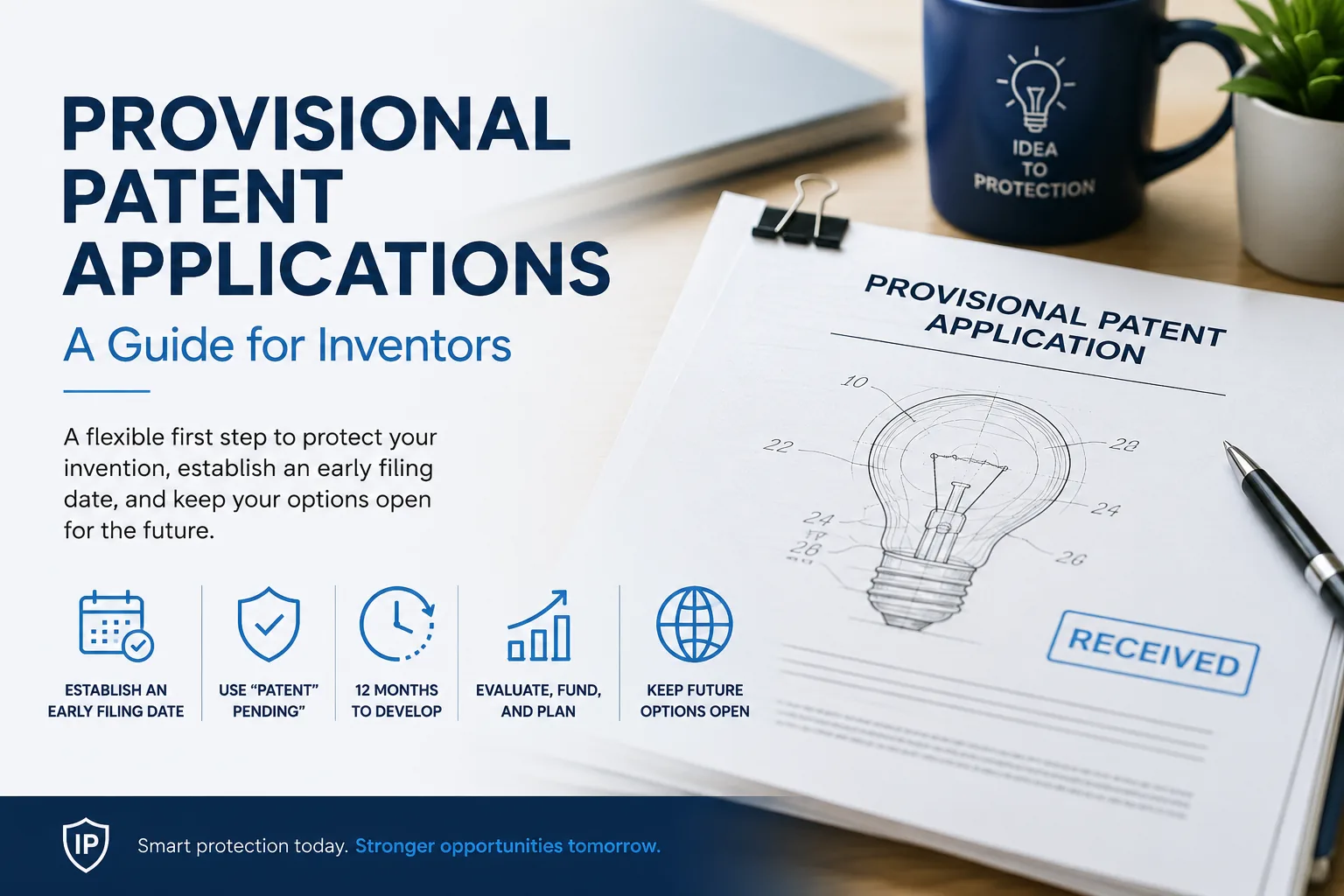
A provisional patent application can be an effective and flexible first step toward protecting a new invention. By filing early, an inventor can establish a priority date, begin using the term "patent pending," and obtain up to 12 months to continue developing the invention, evaluate its commercial potential, seek funding, or prepare a non-provisional patent application.
Provisional applications also have fewer formal requirements than non-provisional applications, making them a practical way for many inventors to begin the patent process. The value of a provisional filing depends on how thoroughly it describes and captures the invention, because the filing date generally applies only to subject matter adequately disclosed in the application.
This guide explains what a provisional patent application is, how it works, the benefits it can provide, what it should include, and what generally happens during the 12-month period after filing.
What Is a Provisional Patent Application?
A provisional patent application is a type of U.S. patent application that allows an inventor to establish an official filing date for an invention before filing a non-provisional patent application.
Unlike a non-provisional application, a provisional application is not substantively examined by the USPTO. The USPTO does not determine at the provisional stage whether the invention is new, nonobvious, adequately described, or otherwise eligible for patent protection.
A provisional application also does not mature into a patent by itself. To pursue an issued patent, the applicant generally must file a corresponding non-provisional application that claims the benefit of the provisional filing date.
Because provisional applications have fewer formal requirements, they can provide inventors with a more flexible way to begin the patent process while continuing to develop the invention or evaluate its commercial potential.
What Does a Provisional Patent Application Do?
A properly prepared provisional patent application can:
- Establish an early filing date for the invention described in the application
- Allow a later non-provisional application to claim the benefit of that date
- Permit the inventor to use the term "patent pending"
- Begin the 12-month priority period for certain foreign and international filings
- Provide time to refine the invention, assess the market, seek funding, or evaluate whether further patent filings are justified
- Temporarily defer heavier costs associated with a full non-provisional application
Securing an early filing date is important because the United States generally follows a first-inventor-to-file system. In general, when different inventors independently develop the same or similar invention, priority is given to the inventor who first files a patent application—not necessarily the inventor who first conceived of or created the invention. A provisional patent application can therefore play an important role in establishing an early priority date without requiring all of the formalities associated with a non-provisional patent application.
What Does a Provisional Application Not Do?
A provisional application does not:
- Issue into a patent
- Create immediate enforceable patent rights
- Give the inventor an automatic right to stop competitors
- Undergo substantive examination by the USPTO
- Guarantee that a patent will eventually issue
- Protect features or improvements that were not adequately disclosed
It is therefore more accurate to view a provisional application as an early patent filing that may support future patent rights—not as a temporary or provisional patent.
For a more detailed explanation, see our guide to what "patent pending" means and what rights it provides.
How Long Does a Provisional Patent Application Last?
A provisional patent application remains pending for 12 months from its filing date.
To preserve the potential benefit of that filing date, the applicant generally must file a corresponding non-provisional patent application within the 12-month period and properly claim the benefit of the provisional application.
Depending on the applicant's international filing strategy, a foreign patent application or an international application under the Patent Cooperation Treaty may also need to be filed within the same period.
If the applicant does not take the appropriate next step, the provisional application expires and ordinarily cannot continue serving as the basis for an earlier priority claim.
Does a provisional application automatically convert into a non-provisional application?
No. A provisional application does not automatically convert into a non-provisional application.
Although inventors often refer to "converting" a provisional application, the more common approach is to file a separate non-provisional application before the deadline. That later application identifies the provisional application and claims the benefit of its earlier filing date.
Why the Quality of the Disclosure Matters
A provisional application generally provides an earlier priority date only for subject matter adequately disclosed in the application. Its value therefore depends largely on how comprehensively it captures the invention. Ideally, the provisional should provide sufficient support for the full range of claims that may later be pursued in a non-provisional application.
For example, a provisional application that describes only a high-level product concept may not support later claims directed to lower-level technical features, implementation details, or variations that were never explained in the original filing.
To secure the best priority date, a provisional disclosure should ordinarily explain:
- What the invention is
- How the invention works
- The components, steps, or system architecture involved
- Different ways the invention may be used or applied
- Alternative embodiments, configurations, and variations
A filing receipt confirms that the USPTO received the application. It does not confirm that the disclosure is complete or that it will support the patent claims eventually pursued.
For a deeper discussion of disclosure quality, see our guide on What Makes a High-Quality Patent Application?
When timing permits, a preliminary patent and prior-art search may also help identify similar technology and the features of an invention that deserve particular attention when preparing the disclosure.
What Should a Provisional Patent Application Include?
A provisional patent application has fewer formal requirements than a non-provisional application, but it should still contain a meaningful and sufficiently detailed technical description of the invention.
Because the provisional application is often intended to support a later-filed non-provisional application, it is generally good practice to organize it using many of the same sections commonly found in a non-provisional application. This can help ensure that the disclosure is complete and well structured.
A provisional application may include a written specification describing:
- The technical background and problems addressed by the invention
- A summary of the invention and its principal components, steps, or features
- A detailed description of how the invention is structured, implemented, and used, including the aspects the inventor believes to be new or inventive
- Different use cases and applications of the invention
- Advantages and technical benefits provided by the invention
- Example claims identifying potential aspects of the invention for which protection may later be sought
The written specification is also commonly accompanied by drawings that illustrate the invention and are described in the specification.
The substance of the disclosure can vary substantially depending on the technology involved. For example, an application covering software may rely heavily on system diagrams, process flows, and implementation details, while applications involving mechanical structures, electronics, medical devices, or chemical compositions may require different forms of technical description and drawings.
For a more detailed discussion of possible sections and content, see:
Provisional vs. Non-Provisional Patent Applications
Provisional and non-provisional applications serve different roles in the patent process.
| Feature | Provisional Patent Application | Non-Provisional Patent Application |
|---|---|---|
| Primary purpose | Establishes an early filing date for disclosed subject matter | Seeks examination and may ultimately result in an issued patent |
| USPTO examination | Not substantively examined | Examined by a USPTO patent examiner |
| Patent claims | Formal claims are not required | Must include one or more patent claims |
| Formal requirements | Has fewer formal filing requirements | Must satisfy more extensive formal requirements |
| Duration | Remains pending for 12 months | Remains pending until it is granted or abandoned |
| Patent-pending status | Allows use of "patent pending" | Also allows use of "patent pending" |
| Possible outcome | Cannot result in an issued patent without a later filing | Can result in an issued patent if the requirements for patentability are satisfied |
| Priority claim | Cannot claim priority to another application | May claim the benefit of one or more earlier provisional applications |
Filing a provisional application is optional. Depending on the circumstances, an inventor may instead proceed directly with a non-provisional application after considering factors such as the invention's stage of development, upcoming disclosure or filing deadlines, available budget, and overall patent strategy.
Can You Add New Information After Filing?
No. New subject matter generally cannot be added to an existing provisional application.
When an inventor develops a new feature, improvement, variation, or implementation after the initial filing, the inventor may consider filing another provisional application describing the new material.
A later non-provisional application may potentially claim the benefit of multiple provisional applications. In that situation, different subject matter may receive different priority dates depending on when each feature was first adequately disclosed.
Inventors should therefore continue documenting improvements during the provisional period rather than assuming that the original application automatically covers everything developed later.
Is a Prototype Required?
A working prototype is not required before filing a provisional patent application.
An inventor may file before manufacturing or fully implementing the invention, provided that the application can describe the invention in enough detail to support the relevant subject matter.
The key issue is not whether a physical or working prototype exists. The more important question is whether the inventor can meaningfully explain how the invention works.
An idea that has not progressed beyond a desired result or general objective may be too underdeveloped for a useful patent filing.
What Happens During the 12-Month Period?
The period after filing can be used to:
- Continue developing and testing the invention
- Build or improve prototypes
- Gather user or customer feedback
- Evaluate market demand
- Seek investors or business partners
- Explore licensing or manufacturing opportunities
- Identify additional embodiments and improvements
- Evaluate U.S. and foreign filing strategies
- Prepare a corresponding non-provisional or international application
The 12-month period should not be treated as passive waiting time. It is an opportunity to develop the technology and make informed decisions about the next stage of patent protection.
Any material improvements developed during that period should also be evaluated to determine whether an additional provisional application may be appropriate.
Monitor USPTO Correspondence
Applicants should monitor correspondence from the USPTO and confirm that the provisional application has been properly processed. When an application is complete, the principal communication will ordinarily be a filing receipt identifying information such as the application number and filing date.
If a required fee, form, or other filing item is missing or deficient, the USPTO may issue a notice requiring corrective action within a specified period. Failing to submit a complete and timely response can result in additional fees or abandonment of the application. Applicants should therefore review all USPTO correspondence promptly and verify that the filing receipt accurately identifies the application and inventors.
For a step-by-step explanation of the required paperwork, USPTO filing fees, and electronic submission process, see our guide to filing a provisional patent application.
Can a Provisional Application Support Foreign Patent Rights?
A U.S. provisional application can provide a basis for claiming priority in later foreign or international patent applications.
Generally, an applicant considering foreign protection must file corresponding applications in the desired countries—or file an international application under the Patent Cooperation Treaty—within 12 months of the provisional filing date.
The provisional application itself does not provide patent rights outside the United States. Separate foreign or international filings are required.
What Are the Main Benefits?
Depending on the circumstances, a provisional patent application may provide several strategic benefits:
Establishing an early filing date
The application can establish an official filing date for the subject matter adequately described.
Obtaining patent-pending status
After filing, the inventor may generally describe the invention as patent pending, which can help deter competitors and bolster marketing materials.
Providing time for evaluation
The 12-month period can be used to evaluate commercial demand, development progress, funding opportunities, and whether the cost of further patent filings is justified.
Delaying heavier patent expenses
A provisional application may postpone some of the costs associated with preparing and filing a full non-provisional application.
Supporting business discussions
A pending application may help demonstrate to investors, licensees, or business partners that the inventor has begun pursuing patent protection.
These benefits depend heavily on the completeness of the application and the applicant's follow-up strategy. For a more extensive discussion, see 15 Benefits of Filing a Provisional Patent Application.
What Are the Main Limitations?
Provisional applications also have important limitations:
- They expire after 12 months
- They are not examined for patentability
- They do not create enforceable patent rights themselves
- They do not guarantee that a patent will issue
- They do not cover later-developed improvements that are not described
- Their filing-date value depends on the quality of the disclosure
A provisional application can be highly valuable when it comprehensively captures the invention and forms part of a deliberate patent strategy. By contrast, a rushed or incomplete filing may provide substantially less protection than the inventor expects.
When Does Filing a Provisional Application Make Sense?
A provisional application may be worth pursuing when:
- The invention is developed enough to describe in technical detail
- A product launch, presentation, publication, or other disclosure is approaching
- The inventor expects to continue developing the invention
- Additional time is needed to evaluate the market
- The applicant plans to seek investors, partners, or raise money
- The applicant wants to delay some of the costs of a non-provisional filing
- U.S. or international filing options are still being evaluated
A provisional application may be less useful when the invention is only a broad concept and the inventor cannot yet explain how it would be implemented.
When Does Filing a Non-Provisional Application Make Sense?
Proceeding directly with a non-provisional patent application may make sense when:
- The invention is already well developed
- The applicant wants examination to begin as soon as possible
- A complete application, including formal patent claims, can be prepared
- The applicant does not expect substantial additional development during the next year
- Appropriate funds are in place to handle costs
- The applicant's U.S. and international filing strategy is already established
- There is little strategic benefit to delaying the full filing
A non-provisional application has more formal requirements and is typically more involved to prepare, but it can proceed directly into examination and may ultimately result in an issued patent.
Can You File a Provisional Application Yourself?
Yes. Inventors are permitted to prepare and file their own provisional patent applications.
However, preparing a provisional application and filing the application with the USPTO are two distinct tasks. The USPTO's electronic filing process involves procedural steps that most inventors can navigate with appropriate guidance. The more difficult task is often preparing a complete technical disclosure that thoroughly captures the invention and provides meaningful support for a later patent application.
Inventors considering AI assistance with that preparation process can also review our AI Patent Drafting: The Complete Guide, which explains how general-purpose and patent-specific AI systems can assist with developing and drafting patent applications.
For step-by-step instructions covering the forms, documents, USPTO Patent Center, and submission process, see How to File a Provisional Patent Application on Your Own.
You can also review the separate guide on how to File a Provisional Patent Online.
How Much Does a Provisional Patent Application Cost?
The cost depends on several factors, including:
- The applicable USPTO filing fees
- How the application is prepared
- Whether the inventor prepares the application independently
- Whether the inventor uses an AI patent drafting platform
- Whether a patent professional drafts or reviews the application
- Whether prior art searches or other services are obtained
Because fees and preparation expenses require a more detailed treatment, this page does not attempt to provide a complete cost breakdown.
You can use our Provisional Patent Cost Calculator to estimate the filing costs of your specific application.
Or read the articles below for a more detailed explanation:
Common Misconceptions
"A provisional application becomes a provisional patent."
No patent is issued directly on a provisional patent application. A provisional patent application is a filing that may support a later application.
"A provisional filing protects the entire idea."
The filing-date benefit generally extends only to subject matter adequately disclosed in the provisional application. If important features are omitted or insufficiently described, claims in a later-filed non-provisional application may not be entitled to the provisional application's earlier filing date.
"The USPTO approves a provisional application."
The USPTO processes the filing but does not substantively examine it for patentability.
"The provisional automatically becomes a non-provisional after 12 months."
A provisional application does not automatically convert into a non-provisional application. To continue pursuing patent protection and preserve the benefit of the provisional filing date, the applicant generally must file a separate non-provisional application within 12 months and properly claim priority to the provisional application. If no timely follow-on application is filed, the provisional application ordinarily expires without being examined or resulting in a patent.
"New improvements are automatically covered."
Improvements developed after the original provisional filing are not automatically entitled to its filing date. An inventor may file an additional provisional application to establish a filing date for the new subject matter. Alternatively, the improvements may be included in the later non-provisional application, but they would generally receive the non-provisional application's later filing date rather than the original provisional filing date.
For additional issues to avoid, see Common Provisional Patent Application Mistakes.
Frequently Asked Questions
Explore More Provisional Patent Resources
Preparing the application
Filing the application
Costs and benefits
Prepare a Provisional Patent Application with Idea2PatentAI
Idea2PatentAI helps inventors develop a more complete invention disclosure and prepare a structured provisional patent application draft.
Our AI patent drafting platform uses a step-by-step workflow designed to help users:
- → Describe the invention in greater technical detail
- → Identify potentially missing, unclear, or underdeveloped information
- → Consider alternative embodiments and potential competitor design-arounds
- → Generate a structured provisional patent application draft using commonly included patent-application sections
- → Download the completed draft in Word or PDF format
Inventors who would benefit from legal guidance, filing strategy, or professional review may also request an introduction to a patent attorney through the free Idea2PatentAI Attorney Referral Network.